
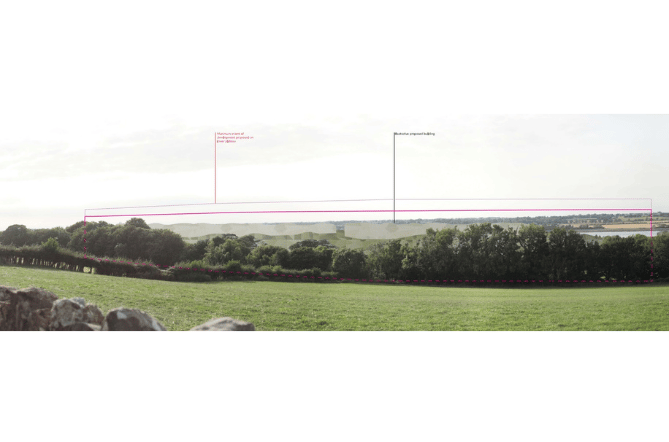
Opposition is growing over over a scheme to develop a massive AI data centre at a former factory on the edge of the Menai Strait.
The Ferodo site at Griffiths Crossing was a major employer for decades with up to 1,500 workers producing vehicle components, particularly brake pads and linings.
Built in 1962, it became famous for the Friction Dynamics Strike which saw workers picketing the factory for almost 1000 days between 2001-2003.
Now locals are protesting a scheme to develop land at, and adjacent to, the site between Felinheli and Caernarfon.
An outline application has been made to Gwynedd Council by the company Gwelyfenai Ltd to develop a 300,440 sqm data centre campus, which includes demolition of existing buildings and structures and re-grading of the land.
A report states: “The vision for the development is to create a highly sustainable digital infrastructure facility that strengthens the Wales data and technology capabilities while responding sensitively to the site’s environmental, landscape, and setting.”
Objectors have highlighted issues from the scale of the development to its impact on locals and landscape, construction, noise and pollution, effect on wildlife and marine environment, potential vast water usage, impact on electricity bills and providing few jobs.
An online petition gathered over 22,000 signatures and a protest walk has been organised in Caernarfon, starting with a 30 minute address, in the town square at 11am this Saturday, 10 October. A march will go around the castle and down Palace Street before finishing at the council offices.
The petition cites the largest building proposed as being 100ft high, and that the development will cover approximately 41 hectares – the equivalent of more than 50 football pitches.
The petition claims data centres elsewhere have resulted in the surrounding areas “being hit with a sharp increase in electricity bills as the local demand sky-rockets,” and that the “vast scale of construction” destroyed wildlife habitats.




However, the developers say the evidence circulated about other data centres does not apply to Canolfan Ddata Menai. They argued the proposal could boost jobs and the economy and reduce electricity bills.
They claimed the proposed site will not use large amounts of water, but a recirculating loop water cooling system.
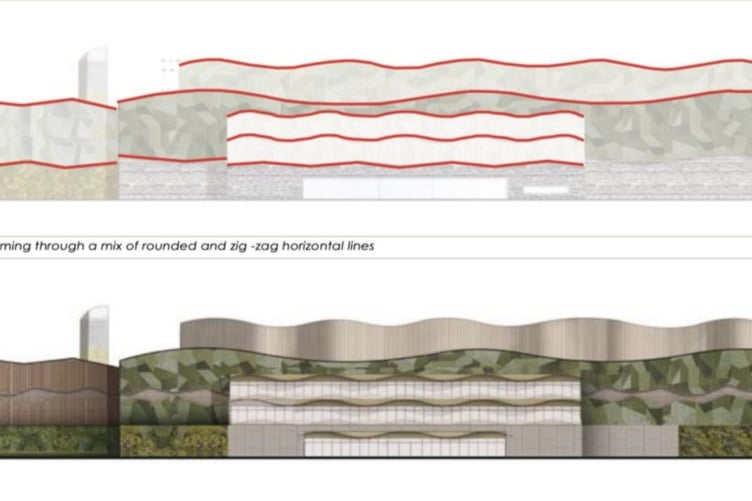
Whilst acknowledging the height of the development, mitigating measures are proposed.
Opposing it, Plaid Cymru’s Dwyfor Meirionnydd MP Liz Saville-Roberts said: “The sheer scale of these proposals is staggering. We are not talking about a modest development, but a data centre complex covering an area equivalent to 57 football pitches on the shores of the Menai Strait.
“Such a dramatic change to this landscape demands the highest level of scrutiny and public engagement.
“The turnout at the last public meeting demonstrated the strength of feeling locally and with over 22,000 signatures now on the petition, it is clear that opposition to these plans is growing by the day. I have listened carefully to residents and I share their concerns.
“Supporters of the scheme point to the prospect of new jobs, but local people are entitled to ask some hard questions. The key question is whether questionable long-term employment benefits genuinely justify a project of this scale. When a proposal of this magnitude is put forward, the burden is on the developers to demonstrate a clear and lasting benefit to local communities.
“Many residents are unconvinced that the number of permanent jobs likely to be created comes anywhere near matching the scale of what is being proposed.
“The combination of public health concerns relating to site clearance and potential contamination, the significant water requirements of the facility, the loss of productive agricultural land, and the broader environmental and landscape impacts lead me to conclude that the risks far outweigh the claimed benefits.
“I do not believe that the development currently represents the right form of investment for our area. Our communities should not be asked to shoulder long-term environmental and infrastructure burdens in exchange for extremely uncertain economic returns.”
Conservative MS for Bangor Conwy Môn, Janet Finch-Saunders, stated: “This development would include a data centre building, back-up generators, associated plant and equipment, and a substation. I am deeply concerned about the proposed AI data centre.
“It will have a significant impact on the local water supply, pollution levels, the amount of energy required to operate the centre, air quality, and potentially the surrounding wildlife and eco-systems.
“Many residents have contacted me to express their opposition, raising environmental concerns and highlighting the potential consequences for the surrounding area and local businesses, particularly given the scale of one of the buildings.”
The Anglesey Sea Zoo, which is opposite the proposed site, said: “It borders several SSSIs and Areas of Natural Beauty, and is adjacent to a Special Area of Conservation, designated to ensure environmental protection.
“Protected wildlife in the immediate area includes otters, grey seals, lamprey, and several species of migratory fish and birds. Is nowhere sacred?
“The Menai Strait is unique globally and if this data centre goes ahead it will completely and permanently destroy this unique and irreplaceable global phenomenon.”
Plaid Cymru’s MS for Gwynedd Maldwyn Beca Brown, added: “The strength of feeling locally about this proposal is clear. Residents have raised legitimate concerns about the scale of the development, its environmental impact, and the pressure it could place on local resources.
“Having considered the views put forward by the community, I share those concerns and oppose the proposal.”
A statement from Gwelyfenai Ltd said: “We fully respects people’s right to raise concerns, protest and participate in the planning process.
“This is a substantial proposal, and questions about employment, wildlife, water, pollution, noise and landscape impact are entirely reasonable.
“Our concern is that some claims now circulating relate to data centres elsewhere or to technologies and operating arrangements that are not proposed at Canolfan Ddata Menai.
“We would encourage people to consider the evidence submitted with this application so that the debate is based on the facts of this particular development.
“North Wales already generates large amounts of low-carbon electricity and hosts the substations, pylons and cables needed to transport that power to other parts of Great Britain.
“If the data centre is built elsewhere, that infrastructure does not disappear. The electricity would still need to be transported through North Wales, further upgrades will still be required, and local communities would still experience the associated disruption and impact.
“The difference is that the area where the data centre is built would receive the investment, skilled jobs, supply-chain work and wider economic benefits.
“Building Canolfan Ddata Menai in North Wales would allow the region to retain more of that economic value.
“Electricity generated in and around North Wales would help create investment, employment and long-term economic activity in North Wales, rather than simply passing through the region to create those benefits somewhere else.
“The campus would connect to the national transmission system through underground cables from Pentir substation. It would not draw its operational electricity from the local SP Energy Networks distribution system serving nearby homes and businesses, and the connection would not require new overhead pylons along the route.
“The independent Economic Impact Assessment estimates that the development would support an average of approximately 915 jobs per year for Welsh residents during its six-year construction programme and approximately 200 permanent operational jobs.
“Discussions have begun with Coleg Menai and Bangor University about apprenticeships, training and courses aligned with the campus’s future requirements.
“The development would also enable the privately funded regeneration of the former Ferodo factory. The site has remained derelict because of the substantial cost of demolition, asbestos removal, contamination remediation and new infrastructure.
“A development of this scale can meet those costs without relying on government or taxpayer funding. The assessment also estimates an annual contribution of approximately £2.1 million to the Welsh non-domestic rates system per year.
“The Environmental Statement assesses terrestrial and marine ecology, water, air quality, noise, traffic, landscape and visual effects. The proposal includes approximately 20 acres of ecological enhancement, together with habitat creation, landscaping and long-term management.
“The campus would not abstract cooling water from the Menai Strait. Its closed-loop cooling system would recirculate water rather than continually taking it from and discharging it back into the environment.
“The only proposed discharge to the Strait is uncontaminated surface water collected through the site’s drainage system. The site has never been connected to Dŵr Cymru’s public sewerage infrastructure, so any services required would need new arrangements agreed with the relevant authorities and service providers.
“The campus’s normal electricity supply would come from the national transmission system. Its proposed generators are standby resilience equipment for controlled testing and interruptions to the grid supply; they are not intended to power the campus routinely.
“The fuel-use figure quoted in some public commentary comes from conservative environmental-modelling assumptions and is not a forecast of normal annual diesel consumption.
“The Environmental Statement identifies no significant air-quality effects for human health or ecological receptors. Operational noise has been assessed at the nearest residential properties.
“With measures including site-specific noise limits, acoustically treated plant, reduced fan speeds at night and screening, the assessment concludes that the operational effect would be negligible.
“The submitted Design Code uses building siting and form, façade treatments, landscaping and screening to reduce the visual impact. These matters will be examined fully through the statutory planning process.
“We are not asking anyone to accept these assurances without scrutiny or to prejudge the application.
“We are asking that Canolfan Ddata Menai is considered on the evidence submitted for this development, rather than on generalised claims about other data centres or entirely different projects.
“Gwelyfenai Ltd will continue to engage openly with residents, community representatives and the relevant public bodies throughout the planning process.”
Comments
We've recently changed our login process. If you have an account for commenting, you will need to re-register on the login window.
This article has no comments yet. Be the first to leave a comment.