
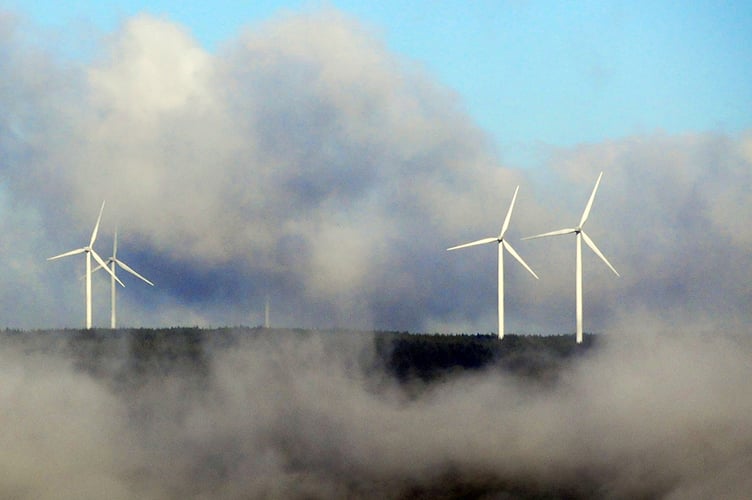
A call to support community and local green energy growth in Ceredigion will be heard by councillors later this week.
The notice of motion at Ceredigion County Council’s full council meeting of 22 January, by Councillor Eryl Evans and Councillor Shelley Childs, Supporting Sustainable Renewable Energy Growth in Ceredigion, asks the council to note three points.
“The urgent need to expand renewable electricity generation to meet national climate targets and the ambitions in Net Zero Wales and Future Wales: The National Plan 2040.
“The concentration of many large-scale, externally owned renewable projects in Ceredigion, and the greater local economic, social, and environmental benefits offered by community-scale and locally owned schemes, particularly those under 10 MW.


“The importance of robust assessment and management of cumulative impacts from wind and solar development, including associated grid and access infrastructure, in line with sustainable development and the Well-being of Future Generations (Wales) Act 2015.”
It asks the council to “champion community-led renewable energy projects (especially <10 MW) that retain value locally, build community wealth, improve energy resilience, and help tackle fuel poverty,” and to “advocate increased use of Welsh Government delivery and funding mechanisms — such as Green Electricity Wales, Ynni Cymru, and the Development Bank of Wales — to incentivise and de-risk community ownership and shared-ownership schemes”.
It also asks for a seven-point call to Welsh Government.
“Ensure a transparent, consistent approach to cumulative impact assessment across all DNS/SIP renewable energy proposals, including related grid and access infrastructure.
“Publish and implement a clear plan to reinforce the electricity grid in Mid and West Wales, to enable greater local use of renewable electricity, support the electrification of transport and heat, facilitate green economic development, and strengthen local energy resilience.
“Improve coordination between the consenting of renewable energy projects and delivery of their grid connections so major schemes are not approved without connection certainty.
“Introduce minimum local ownership expectations for projects over 10 MW—requiring all schemes include meaningful local ownership and an appropriately managed community benefit fund that is guided by local priorities as a condition of consent.
“Strengthen environmental safeguards to protect peatlands, water environments, biodiversity, and the special qualities of the Cambrian Mountains, avoiding unintended adverse impacts on ecosystems and landscape visual character.
“Explore the development of an Interim Ministerial Planning Statement on electricity infrastructure that considers undergrounding where appropriate, while seeking to minimise the impacts of overhead alternatives.
“The approach should include reviewing the suitability of larger steel lattice pylons and inviting views on potential incentives and financial support for community-led energy projects, as well as opportunities to encourage innovation in cost-effective undergrounding solutions.
“Enhance the role of local authorities in renewable energy decision-making—ensuring processes such as the Local Impact Report have sufficient time, resources, and influence to meaningfully address cumulative impacts and other important local concerns.”
Comments
We've recently changed our login process. If you have an account for commenting, you will need to re-register on the login window.
This article has no comments yet. Be the first to leave a comment.