
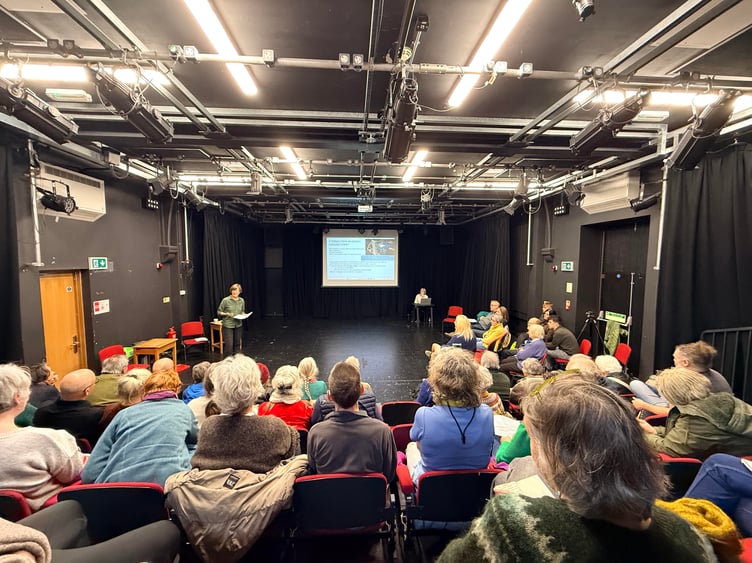
Calls for stronger political action over proposed wind farms and electricity infrastructure were made at a public meeting in Aberystwyth, where speakers raised concerns about pollution, peatlands and the financial benefits reaching rural communities.
The event, Rethinking the Green Transition in Ceredigion, was held at Theatr Arad Goch on Saturday, 7 November.
Organised by Greener Aberystwyth Group and chaired by Aberystwyth University professor Rhys Jones, it brought together experts in river science, ecology and law.
Among developments affecting the wider area are Bute Energy's proposals for up to 37 turbines at Waun Hesgog near Talybont and EDF's early-stage plans for up to 27 at Nant y Maen, east of Tregaron.
Professor Mark Macklin examined the legacy of metal mining, explaining how lead and other pollutants can remain in riverbeds and floodplains long after mines have closed.

Drawing on research into Ceredigion's waterways and the aftermath of the 2012 floods, he warned that disturbing contaminated soils and sediments during major infrastructure works could create additional environmental risks.
He urged careful mapping and assessment before development.
Doug Lloyd, Ceredigion wildlife officer for the Wildlife Trust of South and West Wales, challenged the perception of upland areas as empty landscapes with little ecological value.
He described the importance of peat bogs, heathland and wildlife habitats across the Cambrian Mountains, highlighting their roles in storing carbon, retaining rainwater and supporting biodiversity.




Mr Lloyd also questioned the logic of restoring damaged peatland while potentially widening access routes for wind farm construction nearby.
Mr Lloyd warned that maps may underestimate peat depths, with implications for wind farm construction, Professor macklin echoed this concern regarding careful mapping and assessment before development.
Lorna Brazell, a lawyer and trustee of the Cambrian Mountains Society, turned to the economics of renewable electricity.
She questioned how subsidies, grid constraints and the location of proposed developments affect consumers, and whether community benefit funds adequately compensate areas hosting the infrastructure.
"Why not build the right grid and then build the generation where it's needed to connect that grid to its consumers?" she asked.
The discussion also brought criticism of political engagement.
Attendees expressed frustration at the limited presence of elected representatives, although Reform UK's Claire Archibald, an MS for Ceredigion Penfro, attended.
During questions, calls were made for politicians at local, Welsh and UK level to take a firmer approach.
One contribution argued that Ceredigion County Council should be taking a stronger position on the proposed developments.
In January, however, the council passed a motion supporting community-owned renewable energy and seeking stronger safeguards for peatlands, waterways, biodiversity and the Cambrian Mountains.
It also called for better coordination between major projects and their electricity grid connections.
The Welsh Government is currently consulting on making underground cables the default for new electricity lines between 11kV and 132kV, although the proposed policy is not yet in force.
Developers have previously said proposed wind farms would help Wales reduce reliance on fossil fuels, create jobs and fund local community projects.
The meeting highlighted the challenge of meeting those ambitions while protecting the landscape and ensuring local people have a meaningful say.
Comments
We've recently changed our login process. If you have an account for commenting, you will need to re-register on the login window.
This article has no comments yet. Be the first to leave a comment.