
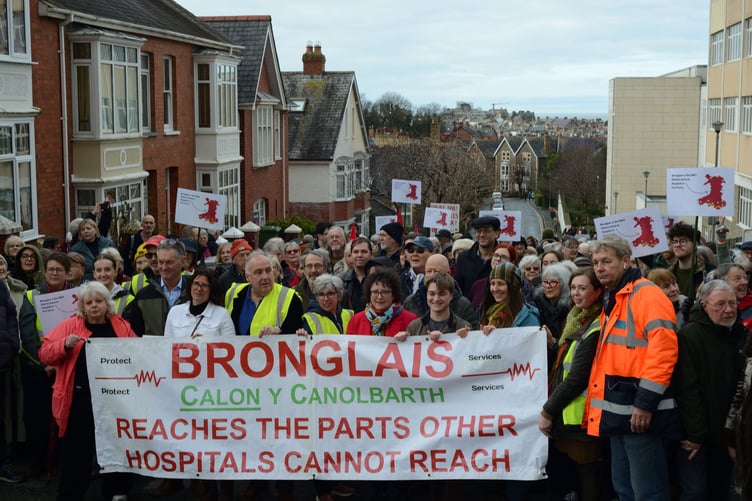
Decision day on the future of stroke services at Bronglais Hospital in Aberystwyth looms as Hywel Dda Health Board will hear at a meeting on 26 November that eight out of 10 people In Ceredigion strongly oppose the change.
Hywel Dda University Health Board endorsed the launch of a second phase of public consultation on the future of stroke services across its four main hospitals in late May.
It formed part of the wider Clinical Services Plan that the Health Board engaged upon in summer 2025.
A public consultation on the Clinical Services Plan last year drew more than 4,000 responses and led to a large protest meeting in Aberystwyth’s Great Hall, and more than 17,000 signing one of the biggest petitions in the Senedd’s 26-year history.
Hywel Dda Health board members in February were told the current service being offered was not achieving the standards required, but the board was told the service is safe currently.
No definite decision was made at that meeting on the future of stroke services, but a new plan then emerged - an amalgamation of new options presented to the health board in February.
The preferred option being consulted on includes a 24-hour acute stroke and rehabilitation unit at Glangwili Hospital; a stroke rehabilitation unit at Bronglais Hospital; and treat and transfer services at Bronglais, Prince Philip and Withybush hospitals, with patients transferred to Glangwili Hospital or a specialist thrombectomy centre where appropriate.
Hywel Dda said more than 3,000 people shared views in the consultation which ran from 28 May to 26 July 2026.
A report into the consultation, which received more than 700 questionnaire responses and included over 120 events and engagement activities, found that nearly eight in 10 Ceredigion respondents opposed Hywel Dda University Health Board’s preferred proposals.
As health chiefs prepare to decide on 26 November whether to centralise specialist acute stroke treatment at Glangwili Hospital in Carmarthen, with Bronglais Hospital in Aberystwyth providing initial treatment and rehabilitation, the report to be put before Health Board members show that of 242 respondents identified as being from Ceredigion, 192, or 79 percent, disagreed that the preferred option would improve clinical standards, patient safety and staff shortages.

Of those, 168 strongly disagreed.
Across the health board area and beyond, 517 of the 745 people who answered the question disagreed, representing 69 percent, while 176, or 24 percent, agreed.
Among Ceredigion respondents who considered previously proposed alternatives, 167 chose “none of these”, while 46 preferred Option 210, which envisaged 12-hour specialist cover at Bronglais for ongoing inpatient care.
This also suggests dissatisfaction extended beyond the health board’s latest preferred model.
Under the preferred option identified by the health board, Glangwili would become the centre for round-the-clock specialist acute stroke care.
Patients presenting at Bronglais, Withybush or Prince Philip hospitals would continue to receive initial assessment and urgent treatment before transfer for specialist inpatient care where required.
Bronglais would retain a stroke rehabilitation unit, enabling appropriate patients to return nearer home for their recovery.
The report records repeated concerns from rural communities about long journeys, poor or unreliable public transport and the availability of ambulances for hospital transfers.
At public events in Aberystwyth and Lampeter, participants also raised the impact on relatives visiting patients in Carmarthen, particularly during winter and for families without cars.
One participant at the Aberystwyth event said: “You cannot consider an option without looking at transport.”
The report also documents concern over whether Glangwili could accommodate additional patients, and whether adequate staffing and beds would be available.
In written representations, Ceredigion Disability Forum argued that the preferred approach would disproportionately disadvantage older and disabled residents and people living in rural communities.
Campaign group Protect Bronglais Services (PBS) called instead for a rural stroke model centred on the Aberystwyth hospital.
PBS said: “The same concerns and fears that were captured during the first consultation process have been expressed just as widely and vociferously in this second phase.
“The responses show an overwhelming lack of trust in the Health Board and little confidence that its preferred option will result in better stroke services and lead to improved outcomes.
“Reducing the current service from four acute stroke units to just one within such a vast Health board area will have a massive impact on access to stroke care and treatment
Hywel Dda says specialist stroke cover is not currently available seven days a week across its hospitals. It believes concentrating staff and resources could improve treatment, safety and patients’ prospects of recovery.
The health board has also stressed that patients would continue to attend their nearest hospital for the initial assessment and emergency treatment of suspected strokes.
Responses from all areas are being considered alongside clinical evidence, staffing requirements, transport arrangements and the costs of implementing any changes.
The health board said: “Stroke services are fragile and currently do not meet national clinical standards.
“The need for change is driven by evidence that patient outcomes are improved when stroke specialist services are concentrated in centres with access to the full range of expert teams and specialist equipment.”
“Stroke services are currently provided at Bronglais, Glangwili, Prince Philip and Withybush hospitals.
“However, these services do not consistently meet national clinical standards and there is no specialist stroke cover available 24 hours a day, seven days a week.
Lee Davies, Executive Director of Strategy and Planning at Hywel Dda University Health Board, said: “Across Hywel Dda, we need to improve access to specialist stroke care, so our services are safe, sustainable, accessible and kind for patients and staff.
“I would like to thank everyone who took the time to participate in this consultation and share their views on the future of stroke services.
“We recognise the strength of feeling and interest in these proposals, and I would like to reassure people that no decision has been made. Whichever option is chosen, the initial assessment and treatment of a suspected stroke would remain unchanged. The proposals focus on the specialist stroke care that follows."
The board is due to consider the future model at a public meeting on Thursday, 26 November.
Members have been asked to “consider conscientiously the consultation findings and “decide on the future model for stroke services, considering the preferred option, the four options discussed in February 2026, consultation findings and updated information; or identify the further work needed before a final decision.”
Comments
We've recently changed our login process. If you have an account for commenting, you will need to re-register on the login window.
This article has no comments yet. Be the first to leave a comment.