
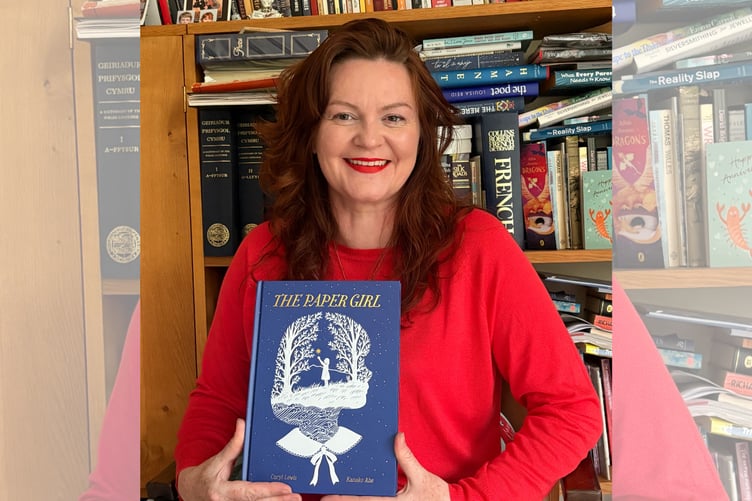
“When my daughter was seven, I remember thinking how fearless she was.
“I was suddenly aware that the world would soon start encroaching, telling her what to be, who to be, how to look.
“I wrote this as an armour for her, to protect her from that.”
Caryl Lewis explained she hadn’t intended her new book The Paper Girl as a pep talk for girls of all ages, but that is what it’s become: “Talking to my friends who are all in our 40s now, we still struggle.
“There’s a ‘good girl’ trope we fall into very young, and it's difficult to break, feeling like you have to fold yourself in a thousand ways to please everybody else.
“[Now] it is still so hard to set boundaries, to say no to things.
“I wanted my daughter to start off life not in that space. I would be really pleased if she refused to play a role.”
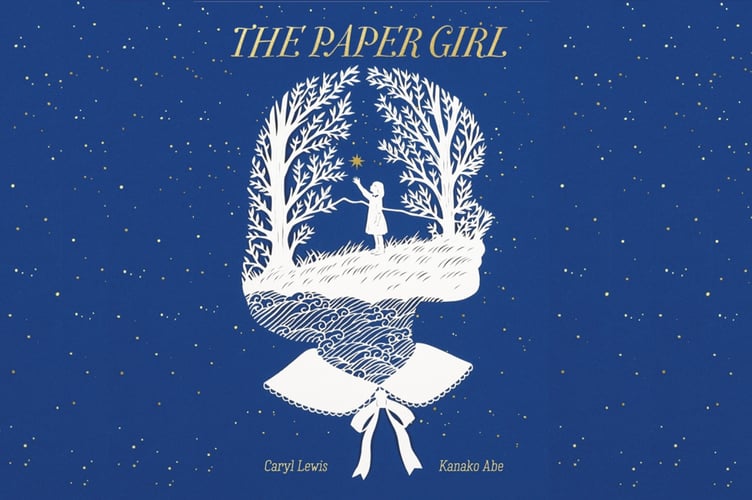
The story follows a girl made from paper who is bright and kind and eager to please - when she is told she should be beautiful, she folds herself into a flower. When she is told she should be clever, she folds herself into a fox - except nothing is ever quite good enough.
Sitting in her Aberystwyth office in front of a sea of books, the multi-award-winning Welsh novelist explains that her new children’s book is a call to recognise those expectations and not take them as your own.


To do this, Caryl created a new-age fairytale. The book combines intricate Japanese kirie (paper-cutting art) by Kanabo Abe, evoking a tale that exists outside of time.
Though Caryl says she grew up on Welsh, English and German fairytales, and “timeless” tales by Joan Aitken, this is the first time she’s tried to create her own.
“Like with the Welsh language and with every ancient thing, it must stay relevant, or it dies,” she adds.
“A lot of fairytales are quite sexist.
“Rather than reimagining old ones, I wanted to bring a new one in that would advocate for young girls.”
Having written in Welsh for 20 years, her writing has now been translated into 25 different languages; The Paper Girl will be published in English.
Though her writing is now part of the Welsh curriculum, she doesn’t want to be kept in the category of a Welsh writer.
“It’s a joyful juggle of wanting to be known as a Welsh writer but not being confined as one.
“Working in Welsh, there is an element of conservation and preservation, but I’m very conscious that representing a culture has its own costs.
“In the past, not so much now with better translation, even your greatest successes would be invisible to the outside world.
“I wanted to reach more languages to connect to people who love stories, wherever they are.
“It’s a door for them to walk through, an introduction to somewhere they may never have heard of.”
The Paper Girl will be released in the UK on 8 October this year.
Comments
We've recently changed our login process. If you have an account for commenting, you will need to re-register on the login window.
This article has no comments yet. Be the first to leave a comment.