
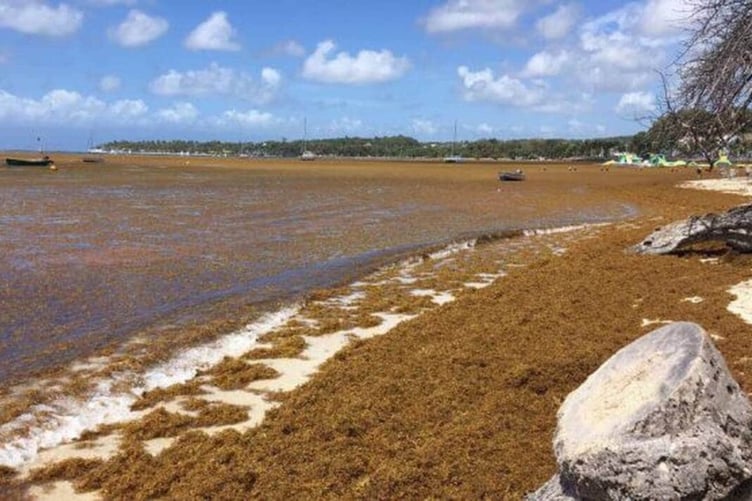
When people picture Brittany and Normandy, they usually think of tides, fishing ports, granite coastlines and long beaches. Seaweed belongs naturally to that landscape. But when large quantities accumulate in the wrong place, at the wrong time, the picture changes. What is part of a marine ecosystem can become a material that has to be collected, moved, monitored and sometimes treated as a nuisance.
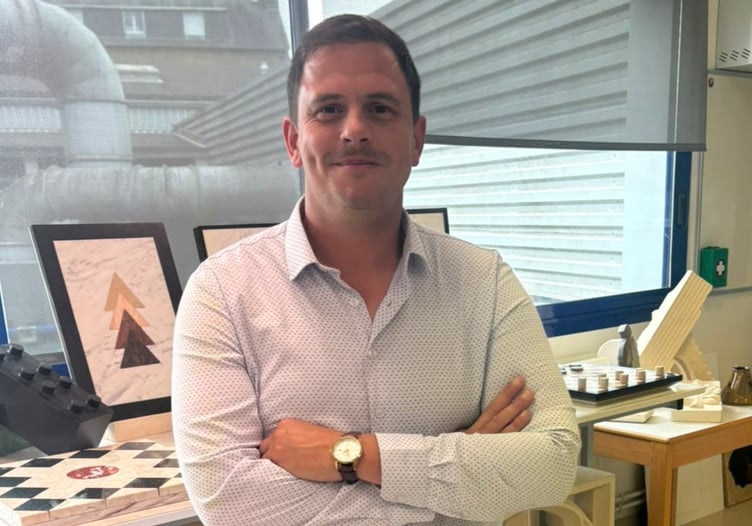
My own work began with a simple question: if coastal communities are already dealing with stranded biomass, could a carefully prepared fraction of it be treated not only as something to remove, but as a possible secondary raw material? I work in construction materials in France, with a background rooted in concrete production, laboratory practice and teaching. That naturally led me to ask whether marine algae could have a place, even a very modest one, in cement-based materials.
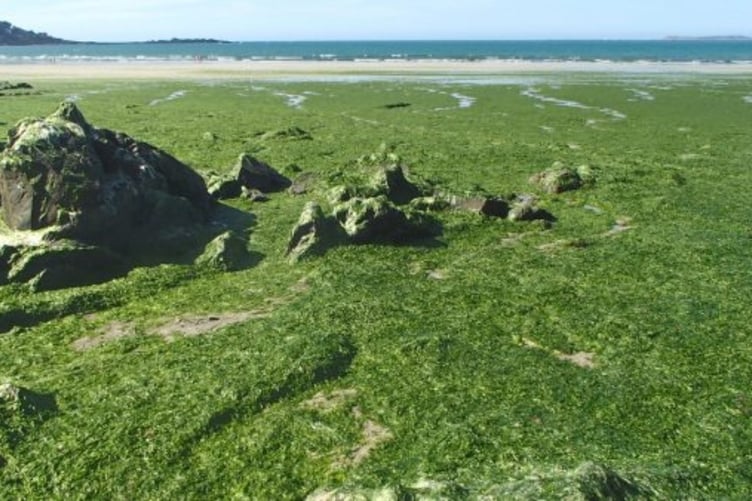
The project took shape on the French Channel coast, between Normandy and northern Brittany - a landscape that includes the Bay of Mont-Saint-Michel and the wider Cancale and Saint-Malo area. The main French thread is green seaweed, particularly Ulva species. Anyone who has seen a dense green accumulation on a shore immediately understands the scale of the question: the material is wet, salty, variable and biologically active. It cannot simply be picked up and poured into concrete.
The first stage is therefore preparation. Freshly collected seaweed carries seawater, sand, shells and other debris. Washing is important because salt and chlorides are unwanted guests in many construction materials. The biomass then needs to be dried so that its mass and behaviour become more stable. After drying, it can be ground and characterised before any attempt is made to incorporate it into a cementitious mixture.
In practical terms, I am looking at a sequence that remains deliberately straightforward: collect representative material, wash it, reduce its salt content, dry it in controlled conditions, grind it, then examine what is actually left. Depending on the objective, a thermal step such as calcination or pyrolysis may also be considered, but that changes the material again and has to be justified rather than treated as an automatic solution.
Only after those stages does the construction question really begin. Small laboratory batches can then be used to see how a prepared algal material affects fresh concrete or mortar, workability, density, strength and, later, durability. At this stage I am careful with the language I use: this is an experimental programme in development, not a claim that seaweed has already become a replacement for cement or aggregate. A useful result can also be a negative one if it tells us which preparation route does not work.
The treatment stage is not simply a clean-up: it determines whether one test can be compared with the next. A wet algal sample may contain changing amounts of water, salt, sand and organic matter, all of which can affect a cement mixture. The practical route therefore needs to record mass before and after drying, washing and drying conditions, particle size after grinding and the quantity introduced into the mix. This routine discipline is essential if a coastal sample is ever to become a material that a producer could specify and control.


The project also extends beyond the Channel coast. In the French Caribbean, Sargassum presents a very different problem. These brown floating algae can arrive in enormous quantities and create social, environmental and economic difficulties for coastal communities. From a materials point of view, however, Sargassum cannot simply be treated as a brown version of Ulva. Its chemistry is different, and so are the risks that have to be managed.
Salt remains an obvious concern, but another important issue is arsenic. Sargassum can contain arsenic in forms that require careful analysis. Washing, drying and heat treatment can change how some elements are distributed or released, so a materials project has to consider not only mechanical performance but also leaching, emissions and environmental safety. The aim is not to hide a pollution problem inside a building product. The aim is to determine, step by step, whether a safe and technically sensible route exists at all.
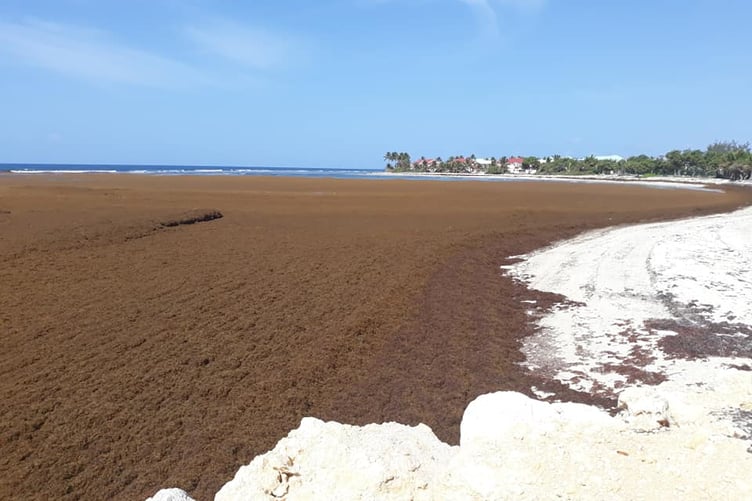
Sargassum illustrates why there can be no single "seaweed recipe". Different species and different coasts bring different salts, mineral contents and contaminants, and therefore require different preparation and safety checks.
Concrete is often described as a simple mixture, yet small changes in raw materials can have large consequences. A powder that looks harmless may absorb water, alter setting, introduce chlorides or weaken a mixture. That is why the interesting part of this work is not the headline idea of 'putting seaweed in concrete'. It is the discipline of turning a highly variable coastal biomass into something measurable, repeatable and safe enough to test.
That need for control is why the work begins with comparison rather than enthusiasm. A sample should be weighed before and after drying, its residual salts and mineral fraction examined, and each preparation route recorded so that one batch can be compared with another. If a seaweed-derived powder is eventually introduced into mortar or concrete, it should be tested beside a conventional reference mixture. The questions are then very ordinary engineering questions: does the mixture need more water, does it remain workable, does it set normally, and what happens to strength over time? Those checks may sound less exciting than the idea itself, but they are what separate a plausible material route from a good story with no technical future. The objective is not to prove that seaweed must work. It is to find out, with enough discipline, where it might work, at what level and under what conditions - or to stop if the evidence says it should not be used.
There is also a question of scale. Collecting a few kilograms for laboratory trials is not the same as designing a regional supply chain. If a material ever moved beyond the experimental stage, its transport, washing water, drying energy, storage and seasonal availability would all matter. A solution that consumes more energy or creates more waste than it saves would make little sense. The environmental balance has to be considered alongside the technical one.
This is where West Wales becomes especially interesting. The point is not to claim that Cardigan Bay has exactly the same algae, the same strandings or the same coastal conditions as Brittany, Normandy or the Caribbean. It does not. The transferable idea is the method: start with the local biomass that actually arrives on the shore, identify it properly, understand when and where it accumulates, and then test whether a safe fraction can be stabilised and characterised for a useful application.
For Cardigan Bay, the first questions would be practical rather than spectacular. What species are present? How wet and salty are they? Do they bring sand or other debris? Are there contaminants that would rule out certain uses? How much material is available, and is it seasonal? Once those answers are known, the same basic pathway used in France could be adapted: washing, drying, grinding, chemical and physical checks, followed by small controlled trials in construction materials.
A Welsh pilot would not need to begin at industrial scale. It could start with traceable collections from selected parts of Cardigan Bay, followed by preparation and comparison of several batches. If the local material proved sufficiently consistent, small mortar or concrete trials could examine workability, water demand and strength beside a conventional reference mix. Washing water, drying energy and transport would also need to be recorded, because a technically successful material would make little sense if preparing it created a greater environmental burden than the coastal problem it was intended to address.
That approach could also help avoid a common mistake in environmental innovation: starting with a fashionable end product and trying to force the waste stream to fit it. The better route is the reverse. Begin with the real material, understand its limitations, then decide whether it belongs in cementitious materials, another building product, or nowhere near construction at all.
What attracts me to this subject is the bridge between two worlds that rarely meet. On one side there is the shoreline, where seaweed is immediate, visible and sometimes inconvenient. On the other there is the construction laboratory, where every gram, percentage and test condition matters. Bringing the two together does not guarantee a solution, but it creates a useful question.
France, Wales and the Caribbean are separated by very different coastlines and very different algal species, yet they share a broader challenge: how to manage biological material that arrives in places and quantities that can become difficult for communities. The answer will not be one universal technology. It is more likely to be a collection of local solutions built on careful testing.
For me, that is precisely why Cardigan Bay is worth thinking about. The most useful lesson from Brittany and Normandy may not be a particular formula or percentage. It may simply be this: before calling stranded seaweed a waste, take the time to understand what it is. In some cases, after enough washing, drying, analysis and testing, part of a coastal problem may reveal itself as a material resource. And if it does not, the testing will have told us why.
Food could be wrapped in packaging made from seaweed instead of artificial plastic in the future, thanks to new research.
In a paper published in the journal Algal Research recently, academics at Aberystwyth University’s Institute of Biological, Environmental and Rural Sciences (IBERS) reveal that seaweed extracts can be turned into an alternative biodegradable plastic.
Plastic films in the food industry are largely made from fossil-fuels. In 2022, they accounted for just under a third of the 400 million tonnes of plastic produced around the world.
Plastic packaging also has a major impact on the natural environment with 15 billion kg of plastic waste entering the marine environment every year.
The west Wales scientists have combined the seaweed extract alginate with other biological compounds to strengthen the new plastic and make it more elastic, so it can be used for food wrappings.
The extracts are made into a powder that is mixed with water, heated and then cast into moulds to create film. The academics have been testing the new sustainable plastics for their strength, antibacterial qualities, water resistance and other properties.
Dr Jessica Adams from IBERS at Aberystwyth University: “It is good news for the planet that seaweed grown in the UK can be used to create more sustainable plastics. Seaweed has so many special and unique properties, not least because films produced from alginate are completely biodegradable, making this a completely circular product.
“Seaweed can be used to form thin, transparent plastic-like sheets that have many valuable traits, making them excellent candidates for replacing food wrapping.”
PhD student, Luke Barnett, who led the study said: “While bioplastics have a long history, plastic packaging, including films, are now starting to shift to environmentally-friendly alternatives.”
The research was supported by the BBSRC and food company Samworth Brothers Ltd.
Comments
We've recently changed our login process. If you have an account for commenting, you will need to re-register on the login window.
This article has no comments yet. Be the first to leave a comment.