

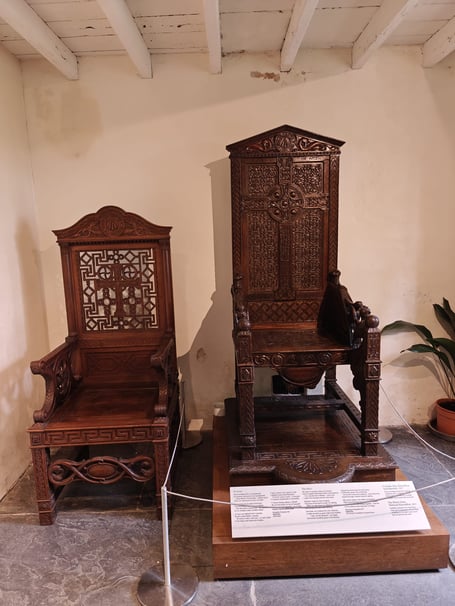
A newly rediscovered National Eisteddfod chair crafted by Belgian refugee and master carpenter Eugene Van Fleteren is on display at Yr Ysgwrn.
The chair, awarded at the 1918 National Eisteddfod in Neath to poet and minister J. T. Jôb, will be exhibited in the parlour at Yr Ysgwrn until autumn, alongside the iconic Black Chair of Hedd Wyn.
Until recently, little was known about the existence of a second chair created by Van Fleteren, the craftsman responsible for the famous Black Chair of the 1917 Birkenhead National Eisteddfod. The discovery reveals Van Fleteren not only designed the Black Chair, but also created another the following year for the 1918 festival in Neath.
Van Fleteren, a refugee from Mechelen in Belgium during the First World War, settled in Birkenhead where he established a furniture workshop. During the war years, more than 4,500 Belgian refugees came to Wales, and Van Fleteren’s work stands as one of the most striking artistic contributions made by those displaced communities.




The chair was awarded to poet J. T. Jôb for his winning awdl, “Eu Nêr a Folant”, at the 1918 National Eisteddfod in Neath. Unlike the tragic story surrounding Hedd Wyn and the Black Chair, Jôb survived to take his seat in Van Fleteren’s second National Chair, making it a symbol of peace and survival at the end of the First World War.
The existence of the chair came to light following a visit to Yr Ysgwrn by Dafydd Jôb, the poet’s grandson, who said the family still possessed the 1918 chair.
Yr Ysgwrn staff described the discovery as an extraordinary moment, as so few people were aware Van Fleteren had created a second National Chair.
Accompanying the display is the hymn ‘A bu tawelwch – wedi’r ddrycin faith”, written by J. T. Jôb on 10 November 1918, the eve of the Armistice.
Comments
We've recently changed our login process. If you have an account for commenting, you will need to re-register on the login window.
This article has no comments yet. Be the first to leave a comment.