
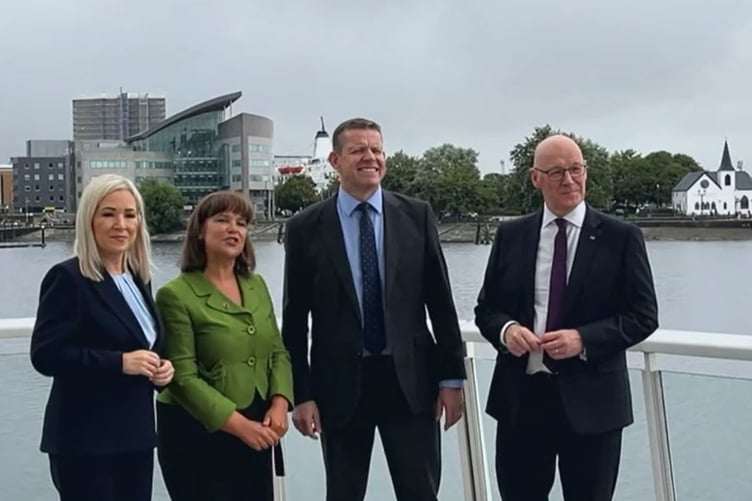
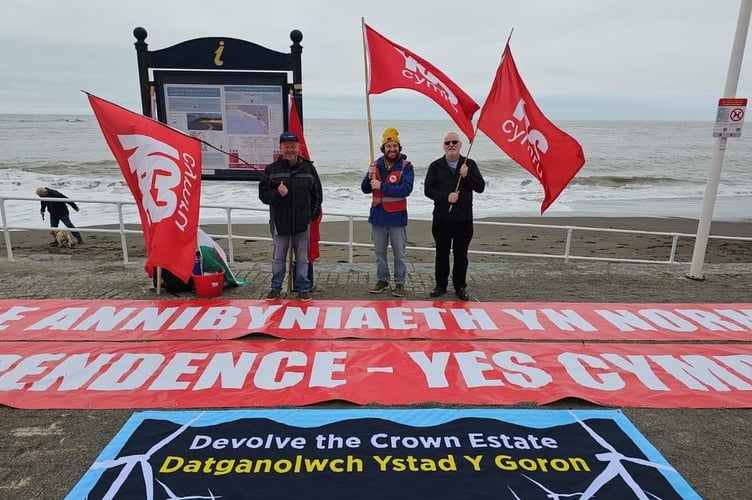
Independence campaigners will take to the streets of Aberystwyth on Saturday, 26 September, calling for Wales to separate from the United Kingdom as political leaders sign a pact declaring they were committed to independence from the United Kingdom.
However recent polls show that 68 per cent of people in Wales are opposed to independence.
Rhun ap Iorwerth, John Swinney and Michelle O’Neill met in Cardiff on Monday, 14 September, to sign a memorandum of understanding which states: “Today, Plaid Cymru, the Scottish National Party and Sinn Féin are coming together to reaffirm our commitment to working constructively with one another in the shared interests of our people.
“We share a belief that the nations and communities we represent deserve greater ambition, greater economic opportunity and a stronger voice in determining their own futures.
“The political landscape across these islands is changing.
“For the first time ever, there are first ministers in Scotland, in Wales and in the North of Ireland who are all committed to independence from the United Kingdom.
“For people watching across these islands – for people watching around the world – there could be no clearer sign that Westminster’s time is coming to an end.
“We believe there is a better way: nations working together as equals, sharing ideas and expertise, and building relationships based on mutual respect and common interests.
“Momentum is behind our movements; we believe that constitutional change is coming.

“We therefore commit to strengthening cooperation between our parties and identifying practical areas where working together can make a real difference.
“We recognise that our parties have different constitutional positions and that each nation will determine its own future in its own way and in its own time.
“What unites us is a determination to ensure that the voices of our nations are heard, that our people have the opportunity to thrive, and that cooperation between Scotland, Wales and Ireland can be strengthened.
“We call for the British Government to prepare for, plan and facilitate constitutional change in each jurisdiction.
“The future should be one in which our nations can cooperate confidently, speak for themselves and build relationships with one another and with the wider world based on equality, respect and mutual benefit.
“Today marks a further step in building that cooperation.”
The agreement states that all three parties want to develop a ‘stronger, fairer economy’, to expand their own energy resources and to rejoin the European Union.
Wales’ First Minister, Rhun ap Iorwerth said: “I’m pleased to welcome the leaders of the SNP and Sinn Féin to Wales at what is an important moment in our politics.
"May’s election was a turning point for Wales. We now have a Plaid Cymru-led Welsh Government with a clear mandate to do things differently.
“Across these islands, we are seeing a new political landscape emerge, with a growing recognition that the Westminster model is no longer working.
"Our parties have much to gain from working together, as partners and as equals, where we share common interests and where cooperation can improve the lives of the people we represent.
"That is the spirit in which we are coming together. I look forward to strengthening the relationships between our parties and taking another step towards a new partnership between our nations.”
.png?width=752&height=500&crop=752:500)
In reaction, A UK Government Spokesperson said: "The Prime Minister is committed to delivering change across all four nations of the United Kingdom and believes strongly in the Union.
“The United Kingdom is at its best when people come together around our shared values and problem-solving rather than division.
“The UK Government is focused on addressing the issues that matter most to families, including easing pressures on household finances and delivering greater economic security, rather than engaging in constitutional debates or further referendums.
“The Prime Minister's approach to working with the First and deputy First Ministers in Scotland, Wales and Northern Ireland is based on partnership and collaboration, focused on delivering growth and good jobs for people across all parts of our country.”
A group dedicated to an independent Wales, Yes Cymru, claims people’s perceptions are changing despite a recent poll showing only 32 per cent back independence
They say a separate question posed by the poll, conducted by Survation, which surveyed 1,023 people, points to a significantly wider potential constituency for independence.
Yes Cymru says: “When all respondents were asked to place themselves on a scale from 0, strongly opposed to Welsh independence, to 10, strongly in favour, 54% placed themselves at 5 or above.
“This includes 34% who placed themselves between 6 and 10, on the pro-independence side of the scale, and a further 20% at the midpoint of 5.
“YesCymru says the findings show that while nearly a third of likely voters are already prepared to vote Yes, there is a much wider section of the Welsh public that could potentially be persuaded to support independence.
“The polling also gives a clear indication of what is currently holding that support back.
“Asked what they believed was the biggest barrier preventing Wales from becoming independent, 46% identified economic fears, by far the most common response.
“By comparison, just 5% said British identity was the biggest barrier, while only 5% identified public opposition or a lack of desire for independence. A further 20% cited government and political factors.” Rob Hughes, the new Chair of YesCymru, said: “These figures show why we believe a majority for independence is within reach. They also show clearly where the challenge lies. We have to build confidence in Wales’ economic future and make the case for how independence can deliver a better country.
“We do not accept that this is as good as it gets for Wales. We believe our country can do better, and we are determined to make the case for an independent Wales that improves the lives of everyone who calls Wales home.”
On Saturday 26 September, supporters from across Wales will gather at Castle Gardens, beside Aberystwyth Castle, before marching through the town, and returning to Castle Gardens for a rally.
The First Minister himself is to attended the rally and speak to those participating.
Other political parties have criticised Plaid Cymru’s push for independence.
Welsh Liberal Democrat Westminster Spokesperson David Chadwick said: “This week’s polling shows that 68% of people in Wales are opposed to independence, and that figure would likely be even higher if people were offered a genuine choice between independence, the status quo and greater powers for Wales within the United Kingdom.
“Plaid Cymru should be concentrating on the day job. Wales has some of the worst NHS waiting times in the UK and an economy that has underperformed for far too long. Those are the challenges people expect the Welsh Government to be focused on right now.
“The Liberal Democrats believe in working together, not putting up new borders. It is why we opposed Brexit, and it is why we oppose independence. But that does not mean defending the status quo. The United Kingdom clearly needs fundamental reform so that power, wealth and opportunity are shared more fairly across all its nations and regions.
“We reject Plaid Cymru’s false choice between independence and carrying on as we are. It is perfectly possible to build a stronger, more confident and more powerful Wales within a reformed United Kingdom, and that is the future Welsh Liberal Democrats will continue to fight for.”
Darren Millar MS, Leader of the Welsh Conservatives, said: “Instead of obsessing about independence, the First Minister should be focused on dealing with the crisis engulfing the Welsh NHS and the declining standards in Welsh schools.
“Grandstanding about referendums will do nothing to improve our emergency departments for vulnerable patients or improve numeracy and literacy for pupils.”
Labour leader in Wales, Ken Skates, said: "Plaid have given people nothing since the election.
"They clearly want to use power to break up Britain, weaken Wales and spend their time obsessing over more powers for their politicians."
Dan Thomas, Reform UK's Welsh leader, said: "The first minister can't get a grip of NHS waiting lists or our education system, but apparently has time to tell us what we all know. That he wants the break up the UK."
Another critic was Chris Bryant, MP for Rhondda and Northern Ireland secretary, who said: "Today Plaid Cymru are meeting to talk about working towards breaking up the UK.
"Since winning power in Wales, other than translating Star Wars to Welsh, and NHS waiting lists starting to climb again, they can't really point to any achievements."
On the issue of Welsh independence, the Institute for Government says: “More Welsh voters are undecided on the issue of independence compared to Scotland.
“Around 20% of Welsh voters say that they are undecided or would not vote in an independence referendum, compared to around 10% in Scotland.
“Support for independence varies between different demographics and party alignment.
“Polls suggest younger voters and fluent Welsh speakers are more likely to support independence.
“Support for independence is unsurprisingly highest amongst Plaid Cymru voters and lowest amongst Conservative voters, and varies by region, with the highest support in mid and west Wales and the lowest in north Wales.”
Plaid Cymru has ruled out an independence referendum before the next Senedd election in 2030.
The issue of independence in Wales has long been a divisive one with devolution for a Welsh Assembly in 1997 only achieving 50.3 per cent of the yes votes, with 49.7 per cent against the idea.
The Welsh Government doesn’t currently have the power to hold a referendum, but Rhun ap Iorwerth says he wants to see that devolved.
The Institute for Government says on that issue: “The question of whether the Senedd could hold an independence referendum has never been tested, since a majority for this policy has never existed.
“However, precedent from the Scottish independence debate suggests that the Senedd could not hold a referendum on independence unless it were empowered to do so by the UK parliament.
“The Wales Act 2017 lists “the union of the nations of Wales and England” and “the Parliament of the United Kingdom” as ‘reserved’ matters that the Senedd cannot legislate on.
“In November 2022, the Supreme Court unanimously ruled that similar language in the Scotland Act prevented the Scottish Parliament legislating for a referendum without Westminster consent, saying “it is plain that a bill which makes provision for a referendum on independence – on ending the union – has more than a loose or consequential connection with the union.
“Any Welsh independence referendum would therefore almost certainly require the passage of authorising legislation at Westminster, as occurred in advance of the Scottish independence referendum in 2014 when the power to organise such a vote was temporarily devolved.”
Speaking at the press conference on Monday, SNP Leader John Swinney said: “This discussion comes the week after the Prime Minister accepted that a referendum should take place when there is majority support for independence in Scotland. That acknowledgment that the people of Scotland can and should determine their own constitutional future is long overdue.”
He also described Andy Burnham as the "last prime minister of the United Kingdom".
President of Sinn Fein Mary Lou McDonald said: “Ireland, Scotland and Wales have different histories and different constitutional circumstances. Those differences must be respected.
“But there is an important democratic principle that we share - nations must have the right to shape their own future.
“In Ireland, the position is clear. The Good Friday Agreement provides a peaceful and democratic pathway to reunification and guarantees the right of the people of this island to determine our constitutional future.
“No British Prime Minister can take Irish unity off the table. Ireland’s future will be decided by the people of Ireland.
“The debate on unity is already underway. A referendum on Irish unity is not something to fear. It is something to prepare for.
“That means doing the serious work now on our economy, public services, rights and institutions, and ensuring that people from every community and tradition have a real voice in shaping the future.
“Irish unity is no longer a distant aspiration. It is a serious contemporary political project, and the work of preparing for the new Ireland must happen now.”
Comments
We've recently changed our login process. If you have an account for commenting, you will need to re-register on the login window.
This article has no comments yet. Be the first to leave a comment.