
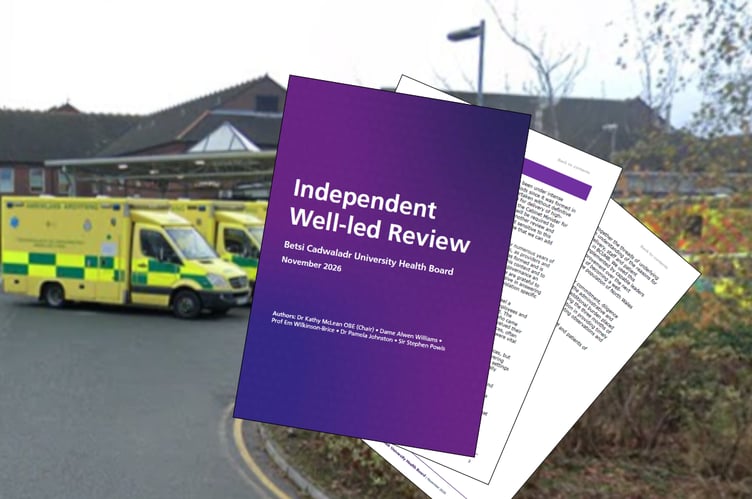
‘Immature and ineffective’ governance has prevented Betsi Cadwaladr University Health Board from pulling itself out of special measures according to a damning report.
The Independent Well-Led Review published today has recommended a two-year programme to get the board back on track and functioning to deliver healthcare services effectively.
Commissioned by Welsh Government and led by NHS Wales Performance and Improvement, it stopped short of recommending changes to the senior leadership – setting out instead a plan for the current leadership to make the necessary improvements with support and monitoring.
The review was conducted by an expert panel led by Dr Kathy McLean OBE and written in conjunction with an Expert Reference Group to determine what was going wrong at BCUHB and what it would take to deliver sustainable improvement for health services across North Wales.
BCUHB is Wales largest health board, covering the whole of North Wales. It was put into special measures – also known as escalation level five – by Welsh Government in February 2023.
When it had failed to significantly improve by July 2026 the new Welsh Government commissioned this report.
The panel did not blame the size of the board for its problems however – regarding it as a potential asset. Instead it pointed to a ‘lack of strategy’ and ‘unstable collective leadership’.
“The review found that BCUHB does not currently demonstrate the organisational conditions required to deliver and sustain reliable improvement,” said the report.
“It is not functioning as a single coherent organisation due to a lack of strategy and unstable collective leadership. Board governance is immature and ineffective, impacting on the health board’s capability to discharge its accountabilities adequately.”
The result of this, it says, is disengagement and ‘a fear of speaking out or raising concerns’ among staff – something the panel recognised as a serious safety issue.


It says while many staff remain committed and it found areas of good practice, the health board was: “failing to value and support these staff sufficiently to redesign services or continually improve and develop sustainable health care delivery.”
As a result many staff had given up on raising issues as they felt management did not listen and simply moved on.
The report also found that unclear accountability meant all decision-making was centralised – pushed to the Executive Team.
Staff also reported rarely seeing leaders and having a lack of trust or confidence in them, feeling a disconnect between senior leaders and the reality of delivering front-line healthcare.
Among its 21 recommendations it called for an immediate stop to BCUHB’s organisational redesign project Foundations for the Future. While the panel agreed it had identified some of the core issues, the length of time it had taken to address them had simply caused uncertainty and instability through the organisation.
It also made recommendations to more critically review senior leaders, improve communications between leadership and staff and build clinical networks across the health board that put strategic planning back in the hands of clinical leaders across all areas.
The panel was firm in its belief with the right leadership approach, staff trust and confidence could be restored.
In a statement following the publication of the report, Mabon ap Gwynfor MS, Cabinet Minister for Health and Care said: “The health board has been in the highest level of escalation since February 27, 2023, reflecting longstanding and serious concerns.
“Despite previous interventions, the organisation remains significantly challenged, continues to deliver comparatively poor outcomes and has insufficient capacity and capability to deliver the scale and pace of improvement required.
“Unlike previous approaches, which relied on the health board to lead its own recovery with external support, the intervention I announced in June placed NHS Wales Performance and Improvement in the lead.
“These failings are utterly unacceptable. I also share the understandable frustrations of staff and patients alike in North Wales at the lack of progress in delivering and embedding improvements to services and standards of care.
“The review was undertaken by an independent review panel of five experienced NHS leaders, bringing senior operational, executive and medical leadership experience.
“The report identifies that the health board does not currently demonstrate the organisational conditions required to deliver and sustain reliable improvement. It does not function as a single coherent organisation and board governance is immature, impacting on the health board’s capability to discharge its accountabilities adequately.
“The report identifies connected, long-standing organisational weaknesses and recommends a phased approach to stabilise, improve and sustain. This requires stronger governance, accountability and assurance, stable and cohesive leadership, an integrated improvement plan and sustained action to build a more positive and inclusive culture, creating the conditions needed to deliver reliable and sustainable improvement.
“I would like to thank the members of the independent panel for their thorough work and a detailed report. I am accepting all the 21 recommendations, this will provide clarity and direction for the health board and ensure the report’s conclusions directly inform future improvements.
“The review highlights the challenging circumstances in which staff are working and the need for them to be heard, meaningfully involved and empowered to contribute to improvement.
“I am grateful to staff for their continued work caring for patients and for sharing their experiences with the panel. Their involvement will be central to developing a more positive and inclusive culture and delivering sustainable improvement.”
Comments
We've recently changed our login process. If you have an account for commenting, you will need to re-register on the login window.
This article has no comments yet. Be the first to leave a comment.