

More than 100,000 sewage discharges were recorded across Wales last year, as new figures reveal thousands of hours of overflow activity at sites across west and mid Wales.
Surfers Against Sewage’s (SAS) 2026 Water Quality Report recorded 101,176 discharges across Wales in 2025, lasting a combined 822,265 hours, the equivalent of almost 94 years. That works out at around 274 discharges every day, or approximately one every five minutes.
The picture stretches across the Cambrian News area, from Ceredigion and the Teifi catchment to Gwynedd, Pembrokeshire, Carmarthenshire and Powys, with some individual overflows recording hundreds of discharge events during the year.
What do sewage overflow figures actually mean?
Storm overflows form part of the sewerage network and are designed to release excess flow when older combined sewers, which carry both wastewater and rainwater, become overwhelmed.
Welsh Water says the overflows act as a safety valve during heavy rainfall, reducing the risk of wastewater backing up into homes, businesses and streets. Natural Resources Wales permits storm overflows to operate under specified conditions and says permitted overflows should discharge when the capacity of a combined sewer has been exceeded by rainfall or snowmelt.
An overflow operating therefore does not automatically mean an environmental offence has taken place. However, Natural Resources Wales (NRW) says it can take enforcement action where discharges occur contrary to permit conditions, including warnings, enforcement notices or prosecution.
Event Duration Monitors record when overflows operate and for how long. The annual figures therefore show both how often an overflow operated and its cumulative duration.
What does the report say?
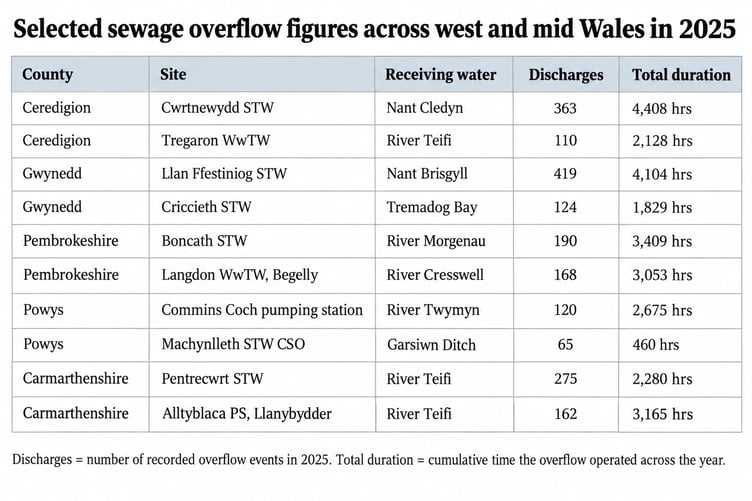
Among the most striking examples identified by SAS was Cwrtnewydd Wastewater Treatment Works in Ceredigion, where 363 discharges lasting a combined 4,408.75 hours were recorded in 2025. It was third in the campaign group’s list of Welsh overflows with the highest number of discharges, behind Llan Ffestiniog and Llanfachraeth.


Separate figures from sewage-data website Top of the Poops, which uses Event Duration Monitoring returns, also place Cwrtnewydd at the top of Welsh Water’s individual sites by discharge duration, at around 4,408 hours.
The River Teifi is another major feature in the data, with overflow sites stretching across several counties covered by Cambrian News.
Alltyblaca pumping station at Llanybydder recorded 162 discharge events lasting around 3,165 hours, with substantial figures also recorded elsewhere along the catchment.
The river runs through or beside communities including Tregaron, Llandysul, Newcastle Emlyn, Cenarth, Cilgerran and Cardigan, linking Ceredigion, Carmarthenshire and Pembrokeshire.
In Pembrokeshire, Boncath Wastewater Treatment Works recorded 190 discharge events lasting around 3,409 hours during 2025, while Llanfyrnach Wastewater Treatment Works recorded 138 events lasting around 2,802 hours.
Further south, Langdon Wastewater Treatment Works near Begelly recorded 168 discharge events lasting just over 3,050 hours.
In Gwynedd, Llan Ffestiniog Wastewater Treatment Works recorded the highest number of discharges among the five Welsh sites highlighted by SAS, with 419 events lasting 4,104.75 hours.
The coastal figures raise separate questions about bathing-water quality, explored later through the example of Tywyn.
Further inland, Powys also features in the data. Commins Coch pumping station, near Machynlleth, recorded 120 discharge events lasting around 2,675 hours into the River Twymyn during 2025.
Powys MP calls for investment
Montgomeryshire and Glyndŵr MP Steve Witherden said a storm overflow at Commins Coch was discharging as he prepared his response to the Cambrian News.
“According to WaterWatch, there is a storm overflow discharging at the Commins Coch station as I write this,” he said.
“It is not enough to say that such sewage discharges are dreadful. We must understand why this happens in the first place and why it happens regularly at Commins Coch; investment must then be put in place to remedy the issue.”
Mr Witherden also welcomed proposed improvements by Hafren Dyfrdwy following Ofwat’s finding that the company had breached legal obligations relating to its wastewater network.
He said: “It is yet another damning indictment of privatisation that Hafren Dyfrdwy had to be fined before it committed to these upgrades. Nonetheless, they are welcome.”
He added that he was separately in contact with Dŵr Cymru over issues in the constituency and had been corresponding with NRW over water-quality testing on the Rhiw.
Mr Witherden said potential upgrades to the sewage station at Llanfair Caereinion could provide lessons for Commins Coch, and thanked Surfers Against Sewage for its work.
Taken together, the figures show very different levels of overflow activity across the region.
They also form part of a much wider Welsh picture. SAS said 90 designated bathing waters in Wales were affected by 4,083 sewage discharges during 2025, lasting a combined 35,669 hours.
The charity argues the scale of the figures raises questions about ageing infrastructure, regulation, monitoring and the possible impact on people using Wales’s rivers and coastline.
What does ‘unpermitted’ mean?
SAS said more than 7,000 “unpermitted” sewage discharges occurred across Wales during 2025.
However, Natural Resources Wales said the term does not mean every event was automatically an illegal pollution incident.
All storm overflows should have an environmental permit setting out when and how they are allowed to operate. NRW said an unpermitted discharge is one from an overflow which does not currently have such a permit.
Water companies are required either to bring these assets into the permitting system or decommission them.
NRW said reported incidents and potential breaches are assessed individually, taking account of environmental impact and compliance with regulatory requirements.
Where there is little or no environmental impact, an incident may be recorded without further action. More serious incidents can result in formal warnings, enforcement notices or prosecution.
The regulator said prosecution is generally a last resort where environmental harm has already occurred.
How can an ‘Excellent’ bathing water still be affected?
The figures at Tywyn highlight an apparent contradiction between storm-overflow activity and official bathing-water classifications.
SAS recorded 156 discharges affecting Tywyn’s designated bathing water during 2025, lasting a combined 818.5 hours, despite the water being classified as Excellent.
NRW said the two measures should not be read as measuring the same thing.
Bathing-water classifications are based on monitoring results collected across four bathing seasons, providing a longer-term assessment rather than a real-time picture of conditions on any particular day.
Of Wales’s 112 designated bathing waters, 110 met the required standards in 2025 and 78 were classified as Excellent.
NRW said water quality can nevertheless change quickly because of rainfall, river flows and runoff from a range of sources, including urban areas, agriculture and wastewater discharges.
An Excellent classification therefore does not mean water quality will remain at that level at every moment throughout the year.

What about the health risk?
SAS argues sewage pollution is also a public-health issue.
Since 2019, the charity has received 992 sickness reports from locations across Wales, associated with 2,258 days off work.
It received a further 187 reports between January and August 2026. Among reports involving designated bathing waters, SAS said 90 per cent were linked to waters classified as Good or Excellent.
The charity stresses that its figures rely on people voluntarily reporting illnesses, meaning they do not represent a comprehensive record of sickness among water users.
They also do not prove that sewage pollution caused an individual illness simply because somebody became unwell after entering the water.
NRW said sickness reports submitted to SAS are not collected or assessed by the regulator, with Public Health Wales responsible for public-health matters including investigating potential causes of illness and providing health-protection advice.
The SAS report nevertheless includes examples of people becoming seriously ill after recreational water use.
Among them was 10-year-old Ollie, who became severely unwell after swimming in the Taf Fechan in May. SAS said he developed a temperature of more than 40C, vomiting, rigors and delirium before spending ten days in hospital.
Doctors treated him with strong antibiotics for a severe unidentified infection which, according to the report, they believed was linked to sewage pollution.
What does Welsh Water say?
Welsh Water said the figures need to be understood in the context of how much of Wales’s sewer network operates.
A spokesperson said much of the system is combined, carrying wastewater alongside rainwater running off roofs, roads and other hard surfaces.
During heavy rainfall, storm overflows act as “safety valves” to prevent sewage backing up into homes and businesses, the company said, adding that discharges at those times are highly diluted.
Welsh Water argued that reducing the amount of rainwater entering combined sewers would lessen pressure on the network and reduce reliance on storm overflows.
It said this would require not only investment in its own infrastructure, but work with councils, developers and others to manage rainwater closer to where it falls.
The company also cautioned against judging environmental impact solely by the number of recorded discharge events.
A spokesperson said: “The UK doesn’t monitor the volumes of wastewater spilt, and a small pipe in West Wales scores the same as a much larger pipe in an urban setting, even though the amount of sewage and the impact will be much smaller.”
Welsh Water said it is investing £889 million between 2025 and 2030 to reduce the impact of storm overflows, targeting work where it believes improvements will make the greatest difference to rivers and coastal waters.
It added that sewage infrastructure was only one source of pressure on Welsh waterways.
“Cleaner rivers and seas also require coordinated action from multiple sectors to address other pollution sources, including industrial discharges, urban and agricultural run-off, misconnected drains and poorly maintained septic tanks,” the spokesperson said.
The company said projects were already under way across Wales and described its approach as focused on investment, innovation and greater transparency around its environmental performance.
What does the regulator say?
NRW acknowledged that storm overflows and pollution incidents continue to affect Wales’s water environment.
A spokesperson said it had strengthened regulation through tighter guidance, increased monitoring and inspections, greater scrutiny and enforcement where standards were not met.
NRW is also overseeing water-company investment intended to improve water quality and reduce the impact of storm overflows, although it cautioned that improvements would take time.
A spokesperson said: “Improving Wales’ rivers, lakes and coastal waters requires sustained action from all sectors.
“We will continue to use our regulatory, monitoring and enforcement powers to hold organisations to account and drive long-term environmental improvements.”
Regulators take action in Powys
The debate over sewage regulation was given fresh significance this week when Ofwat found wastewater company Hafren Dyfrdwy had breached legal obligations over the operation of sewage treatment works and its sewerage network.
Hafren Dyfrdwy operates separately from Welsh Water and provides wastewater services in parts of Powys.
Ofwat said the company had failed to effectively provide drainage and deal with the contents of its sewers, with consequences for customers and the environment.
The regulator said it would have imposed an enforcement order and a penalty of around £255,000, but is proposing instead to accept a package of undertakings valued at £280,000.
The measures include two storm-water balancing tanks at Llansantffraid Sewage Pumping Station to reduce spills and an environmental project creating wetland habitat at Llanfyllin Workhouse.
The cost will be met by the company and its shareholders rather than being added to customer bills.
Ofwat’s decision remains in draft, with a public consultation running until 6 November.
Political pressure grows
The findings have also prompted renewed political pressure for investment and tougher regulation.
Welsh Liberal Democrat Westminster spokesperson David Chadwick MP described the Wales-wide figures as “absolutely shocking”.
He said: “The fact that sewage was discharged into Welsh rivers and seas more than 100,000 times last year, including thousands of unpermitted discharges, should be a source of national embarrassment.
“People should be able to enjoy our rivers, lakes and beaches without worrying about sewage pollution or putting their health at risk.”
Mr Chadwick called for greater investment in ageing infrastructure, stronger independent regulation and “real consequences” for those responsible for pollution.
He added: “The people of Wales deserve clean rivers and seas, and we will keep fighting until we have the regulation and accountability needed to deliver that.”
Comments
We've recently changed our login process. If you have an account for commenting, you will need to re-register on the login window.
This article has no comments yet. Be the first to leave a comment.