
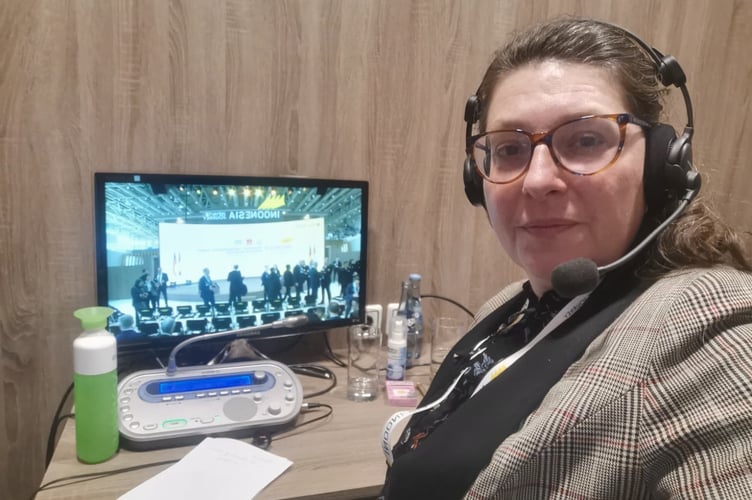
Translators in Wales describe job security as a big concern, as artificial intelligence (AI) becomes a day-to-day tool for the masses.
Sarah Michele from Machynlleth knew it was only a matter of time before she was out of a job due to AI; 10 years ago, she took a job with Google to improve their language models: “I was basically working for the people who would put me out of a job.
“I wasn’t worried at the time. I had a lot of work.”
When the Society of Authors surveyed its 12,500 members two years ago, over a third of translators had already lost out on work due to AI, whilst over a quarter reported decreased income because of it.



Sarah had been a German and Indonesian translator and interpreter for 15 years, but now her jobs have become proofreading AI-translated work.
She said this pays significantly less than raw translation, “even though you have to do a lot of correcting and sometimes rewriting the whole thing, which takes longer than doing it from scratch”.
She predicts that translation will become mostly proofreading AI work, but is worried about machine interpreters causing problems in emotional situations: “Indonesian is such a rare language that I often worked for modern slavery NGOs.
“I worry about situations where people are talking to each other, and the possibilities for misunderstanding and missing the human empathic element.”
The 46-year-old mum’s last translation job was three months ago, and she is now looking to retrain.
It comes as more companies are replacing their translators with AI.
Last month, Harlequin France, owned by Harper Collins, announced that it would be terminating their freelance translators' contracts in place of AI.
Only last year, Amazon’s audiobook provider Audible announced it would begin using AI-generated narrator voices that would translate books across different languages.
Though the fear is embedded - three-quarters of translators believe AI will negatively affect their income - some are trying to adapt.
Siân (not her real name) works for a rural Welsh council and has been incorporating AI into her Welsh translation work: “I use Google Translate to back up my work - I put it through Google to compare the difference and choose what reads best.”
Her local authority has asked her to start using AI tools to speed up her team of seven, creating a memory bank of their work.
Cymdeithas Cyfieithwyr Cymru - the association of Welsh translators and interpreters - has now incorporated an AI proofreading task in their exams, allows use of the internet in their translator assessments, and will be introducing AI proofreading workshops in spring.
Chief Officer Teleri Haf said this shows the association's response to changing technology: “It is clear that we face challenges as artificial intelligence is developing so rapidly.
“AI tools are powerful, but we must remember that they cannot replace the creativity, judgment, and cultural understanding offered by human translators.
“AI should be viewed as a useful tool, not a threat.”
A survey from Cymdeithas Cyfieithwyr Cymru and Arad released last September found that 45 per cent of respondents use AI within their translation work, whilst 70 per cent of companies used AI to translate Welsh.
Respondents highlighted that, on top of fluency in Welsh, the skills needed in their roles were expanding, including needing good IT literacy, understanding of subtitling, web editing, bilingual design skills, and understanding of emerging technologies including AI.
Despite all the challenges, Sian sees AI as a good thing for supporting the learning of Welsh, though the Cymdeithas Cyfieithwyr Cymru survey reported seeing signs and posters propagating incorrect Welsh that may confuse or deter learners.
Siân, 31, said: “I’m not worried that training a machine will put me out of work.
“The world will always need translators.
“Language has nuance and personality and humanity in it.”
Her skill is in choosing the exact words that reflect the region she’s writing for - choosing different words for a leisure centre poster in the north that will speak to that community, compared to 20 miles south - her work reflects the changes in dialect across the Welsh hills, and her place-based knowledge AI doesn’t have.
Sarah’s concern is how AI translation is impacting how we use language: “We’re starting to emulate the machine that emulates us.”
Another main concern highlighted in the Cymdeithas Cyfieithwyr Cymru survey was the ‘monotonising’ of Welsh language in AI-translated text.
Siân said: “Does language belong to people or corporate industries?
“AI requires more water than the population - we can’t rely on machines.
“If all machines went dead and there was no technology in 50 years time, would we still be able to communicate with each other?”
Iestyn Tyne, a writer and translator from Gwynedd, has moved to focus on creative translation after hearing from former colleagues who have become AI proofreaders for their local authority employer: “It’s soul-destroying when you think about the craft as translators.
“When a translator sits down to write, they create new material.
“I’d hope poetry wouldn’t be under threat.
“We can say these things we want to hear like ‘machines are never going to be as good’, but it has developed incredibly fast to where it is now.”
He pointed out that as Welsh translators lose out on work, AI is acting as a coloniser to professional linguists of a formerly oppressed language: ”AI does replicate structures that have historically oppressed these languages.”
As all three translators pointed out, there’s a moral line that has to be drawn by companies in deciding whether they choose human versus AI translation, and whether consumers care whether their media is AI-generated.
To encourage industries to do just that, the Society of Authors last week launched a report calling on the UK government to implement regulatory framework to protect creators' livelihoods.
The CLEAR framework stands for Consent (copyright use), Licensing not scraping, Ethical use of training data, Accountability, and Remuneration and Rights.
They are calling on people to write to their MP to promote CLEAR in parliament - https://societyofauthors.org/2026/01/30/brave-new-world
Comments
We've recently changed our login process. If you have an account for commenting, you will need to re-register on the login window.
This article has no comments yet. Be the first to leave a comment.