

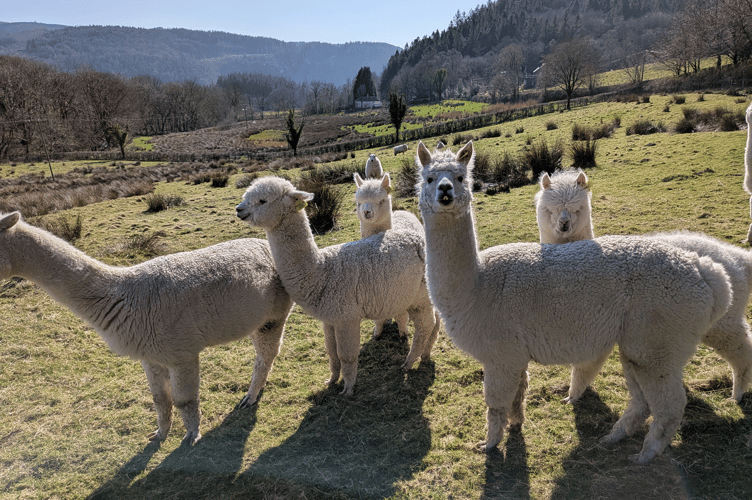
Scientists are studying alpaca and sheep poo collected in the Welsh uplands as part of efforts to protect grasslands and wildlife around the world.
One of the biggest challenges facing animal and ecology experts is finding the best method to determine what different grazing animals eat.
Many different approaches have been used over the years, including trying to identify tiny fragments of digested plants, and creating profiles of selected compounds.
A new study, led by scientists at Aberystwyth University, is directly comparing these different techniques for the first time.



In carefully controlled feeding trials at the Pwllpeiran Upland Research Centre, alpacas and sheep have been fed custom mixed combinations of different pasture types.
The research team then tests different methods for pinpointing the animals’ diets - samples of their faeces will be analysed with DNA metabarcoding, microhistological, n-alkane and long-chain alcohol analyses.
The results of the study, funded by the Joy Welch Trust, will influence the way information on animals’ diets is collected during future grazing experiments around the world.
Mariecia Fraser, Professor of Upland Agroecosystems and Head of Aberystwyth University’s Pwllpeiran Upland Research Centre, said: “When studying grazing animals, one of the biggest challenges facing animal scientists and ecologists is knowing who ate what.
“If we can truly understand what these grazing animals are eating, it can unlock new ways of farming and conservation that will help improve people’s livelihoods and the environment.
“Currently people are examining animals’ diets in a variety of ways, but we don’t know which is best.
“This is the first time alternative techniques have been directly compared.
“Our hope is that this work – involving some of the best experts around the world - can give us a definitive answer on how to decode animals’ diets.
“The better we can refine a technique, the better chance we have of protecting grazers and grasslands.
“For many communities, like those in the Andes, livestock is a vital source of income. These areas are also vital for tackling climate change with extremely valuable peatlands and species.
“We hope this work will help these communities to form their own strategies that meet their needs and those of the planet.”
Researcher Katherine Capuñay Sanchez from the Rangeland Ecology and Utilization Laboratory of the Universidad Nacional Agraria La Molina (UNALM) in Peru will use faecal microhistology to determine the diet of these herbivores.
The n-alkane and long-chain alcohol analysis will be conducted by Professor Luis Ferreira at the University of Trás-os-Montes and Alto Douro in Portugal.
Aberystwyth University’s Professor Fraser added: “This is a vital international partnership – between Wales, Peru and Portugal - looking at opportunities for collaborative research which could protect biodiversity as well as enhancing livestock health and productivity, and supporting the livelihoods of rural communities across the globe - including the Andes and upland areas of Wales.”
The partnership between Aberystwyth University’s Pwllpeiran Upland Research Centre and Universidad Nacional Agraria La Molina in Peru has been supported by the BBSRC and the UKRI’s Global Challenges Research Fund.
Comments
We've recently changed our login process. If you have an account for commenting, you will need to re-register on the login window.
This article has no comments yet. Be the first to leave a comment.