
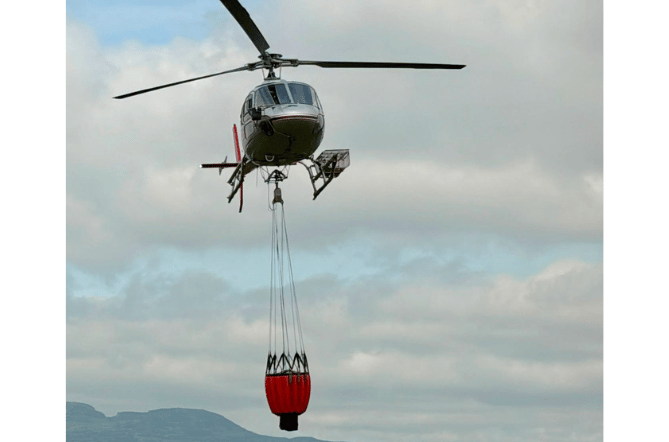
This summer’s wildfires cost North Wales Fire Service an additional £500,000 to manage.
Firefighters found themselves tackling six wildfires at once at one point – more than it had ever faced before – and at its peak through July and August at some points there were only seven fire engines across all of North Wales not involved in getting wildfires under control.
The combination of extreme heat, bone-dry conditions and careless, deliberate acts of littering or vandalism created a perfect storm of ignition risks, helping set brush alight across the region’s rural areas.
Among the worst-hit areas were Halkyn Mountain in Flintshire, Llantysilio in Llangollen, Brynford Hill in Flintshire, Bangor Mountain in Gwynedd, Conwy Mountain in Conwy, Braichmelyn Forestry in Bethesda and Rhinogydd near Harlech.
North Wales Chief Fire Officer Dawn Docx told the October meeting of the North Wales Fire and Rescue Authority that while in the past cutting the number of firefighters has made sense as risks have reduced, the picture has now changed.
“The numbers of firefighters were reduced during the 2010s and austerity and we were successful in our prevention work so the number of fires went down,” she said.
“It might be said that was appropriate given that risks were reducing.
“Now we know over the last five years that risks are increasing. We are seeing risks due to climate change – whether that’s wildfires or flooding – and we’re seeing risks due to the technology that’s been introduced to combat climate change.
“Lithium-Ion batteries, solar panels, electric vehicles are wonderful pieces of technology but they bring with them additional firefighting risks and challenges.
“The UK must invest in fire and rescue services – we need kit and capability. We must train and restructure to combat both wildfires and flooding in future.




“This year was not a one-off. This is the future. This year there was not enough firefighters across the UK to deal with this level of activity.”
North Wales Fire Service (NWFS) is currently applying to the Welsh Government’s Emergency Assistance Scheme to cover the additional costs incurred this summer.
Ms Docx assured members of the authority – who are drawn from across the six counties of North Wales – that the region does not experience the level of arson that other Welsh regions do.
“I still feel however that there needs to be a lot of education in order for people to be safer when they are in the outdoors,” she added.
She called for Wales and the wider UK to learn from countries in Southern Europe where wildfires have been common for some time – suggesting a Wales-wide or UK-wide contract to enlist aerial support through helicopters, aircraft or drones capable of damping down large areas of wildfire quickly.
That resource – according to Ms Docx – was needed by next summer and would need additional investment – although she did not indicate how much and whether there would be an immediate impact on next year’s precept – the part of Council Tax from each local authority that goes to NWFS.
“We are lobbying Welsh Government and UK Government to put together the resources we need,” she said.
Comments
We've recently changed our login process. If you have an account for commenting, you will need to re-register on the login window.
This article has no comments yet. Be the first to leave a comment.