

It is not a good time to live in Gwynedd, Powys, Ceredigion, Carmarthen or Pembrokeshire if you are sick.
Right now, all three National Health Services boards across our region are in dire straits. Week after week, this publication runs stories from each of the boards documenting service failures, long waiting times, poor facilities, and consultations that, whichever way they are worded, boil down to doing much more with much less.
Die-hard Plaid Cymru loyalists will likely saddle up their high horse and proclaim that the party in its proposed draft budget released some days ago, is offering £500m more for the NHS across Wales.
Yes, that is true.
But very little of that £500m will actually come to rural mid and west Wales.
The bulk will be spent where it gets better bang for the buck – and that is in larger population centres along the M4, Wrexham region and along the A55.
The ironic thing is that both Finance Minister Elin Jones and Health Minister Mabon ab Gwynfor – the key decision makers when it comes to funding Wales’ NHS – were both elected from Plaid power bases in Ceredigion and Gwynedd respectively. But how much of their clout – and cash - is being felt at the Hywel Dda and Betsi Cadwaladr boards.
While the pair are likely to point out that they have to remain above the fray and stay out of the day-to-day decisions made at board level, that’s hard for someone waiting for cancer treatment or a new hip to fathom.
Is it too much or too naïve to expect that that people we elect into power should then exercise that power for our good?


For the past year, the people of mid and west Wales have been waiting for the shoe to drop on Bronglais and its provision of stroke services.
The preferred option being consulted on includes a 24-hour acute stroke and rehabilitation unit at Glangwili Hospital; a stroke rehabilitation unit at Bronglais Hospital; and treat and transfer services at Bronglais, Prince Philip and Withybush hospitals, with patients transferred to Glangwili Hospital or a specialist thrombectomy centre where appropriate.
Hywel Dda said more than 3,000 people shared views in the consultation which ran from 28 May to 26 July 2026.
A report into the consultation, which received more than 700 questionnaire responses and included over 120 events and engagement activities, found that nearly eight in 10 Ceredigion respondents opposed Hywel Dda University Health Board’s preferred proposals.
As health chiefs have to decide on centralising specialist acute stroke treatment at Glangwili Hospital in Carmarthen, with Bronglais Hospital in Aberystwyth providing initial treatment and rehabilitation, the report before Health Board members shows that the vast majority of respondents disagreed that the preferred option would improve clinical standards, patient safety and staff shortages.
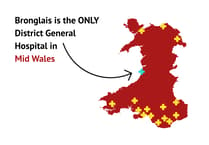
Look at a map of Wales and where hospitals are based, and Bronglais jumps out as the only one of substance beyond the reach of the A55 and M4 corridors.
Plans to downgrade Bronglais only then increases over-stretched facilities at Bronglais, Glangwili, Prince Philip and Withybush hospitals.
But it’s not just stroke services.
Hywel Dda has recorded the worst therapy waiting-time performance in Wales, with almost one in three pathways breaching the national 14-week target, newly published figures reveal.
A third of therapy pathways at the health board were waiting longer than 14 weeks at the end of September, the highest proportion among Wales's health boards.
The 14-week standard covers specified therapy services, rather than all hospital treatment or mental health therapies. Waiting lists can include referrals for physiotherapy, occupational therapy and other specialist rehabilitation services.
Those poor performance levels blow a gaping hole in treat and transfer theories. Patch ‘em up at Bronglais, shift them south, and then forget about offering rehab or therapy.
And in Powys, the Teaching Health Board has acknowledged that it operates the oldest healthcare building estate of any health board in Wales, as it makes the case for controversial changes to local NHS services.
Let’s face it: consultations are largely a sham.
There’s a 14-week one underway by Betsi that could determine whether inpatient beds return to Tywyn’s community hospital or disappear permanently has begun.
Call be a cynic but there’s only one way that will go.
The decision concerns Dyfi Ward, which shut temporarily in April 2023 because of nursing shortages. More than three years later, the ward remains without inpatient beds, despite repeated protests and calls for its reopening from residents concerned about access to rural healthcare.
Betsi has been under special measures for years. It’s the worst-performing board and had the highest-paid chief executive. Funny that.
At least now, Chief Executive Carol Shillabeer is moving on after three-and-a-half years. She’s been named as the new Chief Executive of Lancashire and South Cumbria NHS Foundation Trust in North West England.
Good luck!
Comments
We've recently changed our login process. If you have an account for commenting, you will need to re-register on the login window.
This article has no comments yet. Be the first to leave a comment.