
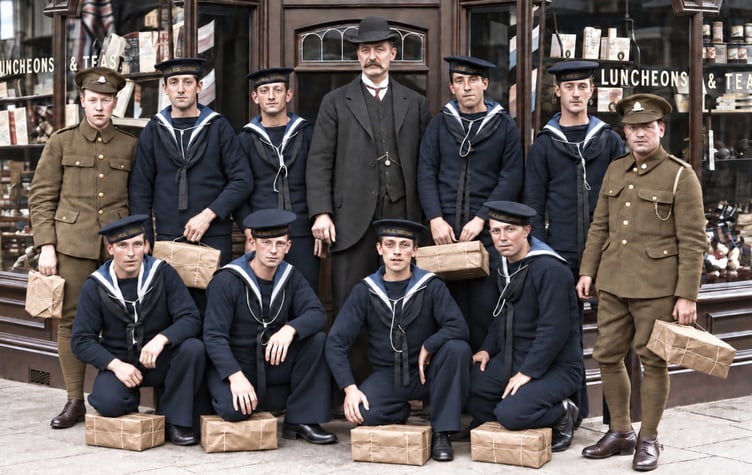
In June 1915, a soldier from Aberystwyth serving overseas asked whether cigarettes could be sent to some of the local men at the front. The request reached Thomas Richard Fear, a retired Regimental Sergeant Major of the Grenadier Guards, who lived with his wife, Mary Ann, at Highbury, Dinas Terrace.
Fear could have arranged a few parcels and left it at that. Instead, he started the Aberystwyth Weekly Comforts for Fighters Fund, which would keep him busy for the rest of the war.
He began asking local businesses and residents for help. Shopkeepers contributed, people gave money, and concerts and other events were organised to keep the Fund going. Before long, between twenty and fifty parcels were being sent out every week.
There were cigarettes and tobacco, cakes, chocolates, socks and other things the men could make use of. At Christmas, special parcels went out containing plum puddings and cakes. Sometimes Fear tucked in a copy of the Cambrian News so that the recipients could catch up with what was happening at home.
He also made a point of enclosing a personal letter or card. Fear kept records of the men receiving the parcels, and when an acknowledgement came back, another could be sent.
The Fund eventually extended its help to wounded men, prisoners of war and women serving overseas.
Many of the letters sent to Fear have survived and are now held at the National Library of Wales. They came from men serving far from Aberystwyth, thanking him and the townspeople for remembering them. It was not so much the value of what was inside the parcels that mattered, but the knowledge that people at home were still thinking about them.
There was, however, a great deal of worry in Fear's own household.
Both his sons were serving in the Army. In July 1916, Richard Gordon Fear, a lance-corporal in the London Rifle Brigade, was wounded. Then, the following year, the family received news that no parent wanted to hear.
His other son, Edgar Frank Fear, was serving as a gunner and signaller with the Royal Garrison Artillery. He had arrived in France on 16 May 1917 and was killed in action on 4 June, less than three weeks later. He was twenty-six.


Edgar was married to Winifred, and they had a young daughter, May. His death left Winifred a widow and their little girl without her father.
By then, Fear had been running the Fund for two years. He had spent much of that time collecting money, organising parcels and writing to men whose families were waiting anxiously for news. Now he had suffered the same loss himself.
He carried on with the Fund. There were still parcels to prepare, donations to collect and men waiting for their next delivery from Aberystwyth.
By the spring of 1918, Fear was also giving thought to how the town should remember its dead. He proposed turning Aberystwyth's Skating Rink into a Memorial Hall, an idea which had already been warmly received by soldiers and sailors.
His work was certainly appreciated at the time. On 26 April 1918, the Cambrian News carried an article entitled Camp Reflections.
The writer urged Aberystwyth Town Council to consider awarding Fear the Freedom of the Borough, praising his "painstaking, self-devoted, and successful efforts in providing comforts for the fighters from Aberystwyth."
Nothing came of the proposal.
When the fighting ended in November 1918, Fear remained involved in helping those who had served. He took an interest in the YMCA's work for returning servicemen and continued to press for a suitable memorial to the town's war dead.
Eventually, the Comforts Fund came to an end. Its records, along with the letters from the men it helped, were preserved. They tell us a great deal about Fear and about the generosity of the people of Aberystwyth during those difficult years.
But today, very few people know his name.
Earlier this year, The Lost Voices of Aberystwyth met with Councillor Carl Worrall to discuss the possibility of placing a blue plaque in the town to commemorate Fear. Councillor Worrall subsequently raised the matter with Aberystwyth Town Council, which has supported the proposal in principle.
Lost Voices believes that few individuals have done more for the people of Aberystwyth over the past 110 years. Fear gave years of his life to helping local men and women serving overseas, even when there was so much grief in his own home.
We would like to see that contribution properly recognised.
In 1918, someone thought Fear deserved the Freedom of the Borough. We are asking for something rather more modest today: a blue plaque to tell future generations who he was and what he did.
The men who received his parcels took the trouble to write back and thank him.
More than a hundred years later, it would be good for Aberystwyth to do the same.
Comments
We've recently changed our login process. If you have an account for commenting, you will need to re-register on the login window.
This article has no comments yet. Be the first to leave a comment.