

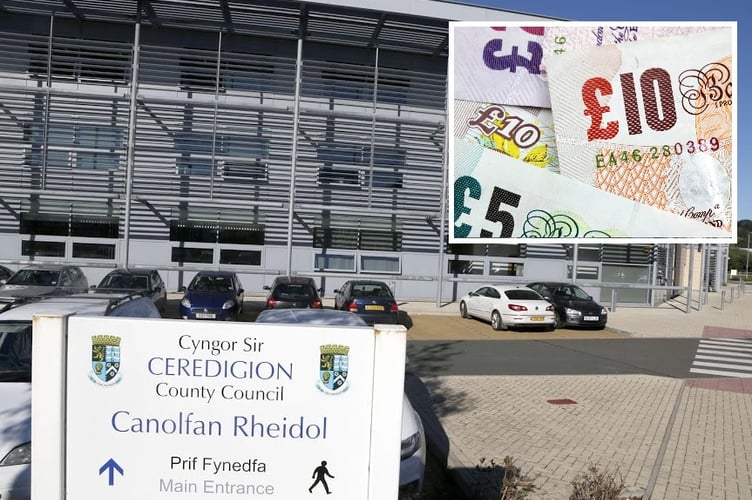
Residents have called for Ceredigion county councillors and senior staff to take a pay cut and for council tax to be frozen after years of above inflation rises, a county council report has shown.
Ceredigion County Council held a ‘budget engagement’ exercise with residents to gather views on where money should be spent, which services could be cut, and what level council tax should be set at.
This year residents in Ceredigion are facing a lower than expected council tax rise in the wake of extra local authority funding from a Welsh Government budget deal, with finance chiefs now aiming for a council tax increase of 4.75 per cent from April.
Despite the lower increase than in previous years where residents have been facing council tax rises in to the double digits, 45 per cent of all respondents to the engagement said they would not support any increase in council tax at all.


A council report into the engagement exercise said that 300 people responded to give views, with 290 of them residents in Ceredigion.
Overall, the council report said that it received 200 suggestions on how the council could address the budget gap in 2026-27.
“The most identified suggestions were to reduce corporate and administrative costs, increase efficiency and reduce waste, and prioritise essential services,” the report said.
The “most prevalent themes for cuts”, the report said, were “management salaries, cuts to general staff costs, and to make efficiency improvements” as well as management pay and staffing and council administration.
The report also outlined that residents would like to see “corporate and organisation-wide efficiencies, such as reducing overheads, staffing costs, estates and procurement.”
“A large proportion of cut-related comments targeted senior management pay and higher salaries,” the report said.
“Most efficiency related comments focused on streamlining processes, challenging procurement scope and fees, reducing consultancy costs, and cutting admin and back-office roles.”
The report revealed that 89 per cent of those who responded supported a reduction in spending on elected members’ salaries, while 70 per cent supported a reduction in capital financing costs and 69 per cent supported a reduction in the council tax reduction scheme.
The council’s report said that despite support for those reductions “there was little scope to do so.”
Calls were made to adjust or reduce charges for toilets and parking in a bid to increase footfall in town centres, while others said the council should share costs and specialist roles with neighbouring councils to ease the financial burden.
The report said that “there was some appetite for reducing the budget for the three main frontline services – 34 per cent for Through-Age Social Care and Well-being, 41 per cent for Schools and Lifelong Learning and 29 per cent for Highways and Environmental.”
“However, a majority of respondents did not want to see cuts to the main frontline services of Through-Age Social Care and Well-being, Schools and Lifelong Learning and Highways and Environmental, although they could not agree on how that should be funded.
“There was also a much larger appetite for reducing spending on all other services – 85 per cent for Democratic Services, 72 per cent for Legal Services, Governance and People & Organisation, 69 per cent for Policy Performance and Public Protection, 64 per cent for Finance and Procurement and 59 per cent for Customer Contact, ICT & Digital.”
The most responses received was on the issue of council tax, with residents bearing the brunt of rising costs and inflation over the past five years.
The council report said: “When asked directly for their views on council tax levels, respondents were divided in their tolerance for increases.
“The largest proportion of 45 per cent did not support any increases to council tax in 2026/27 even though this would mean cuts to services, including closing some services completely.
“The remaining 55 per cent would accept an increase in council tax but to varying degrees.”
The report said that 38 per cent of people “supported a smaller increase in council tax of £5 to £10 per month but understood there would still be some cuts to services” while seven per cent “supported a £15 per month increase in council to help protect frontline services”, and 10 per cent “supported a larger increase of £20 to £25 per month to protect frontline services and allow some investment in services.”
The report said that residents wanted “corporate savings as a priority before raising council tax” and that many perceived council tax as “poor value for money”, with the “perception that council tax is too high for the services provided.”
Early indications about an expected budget for 2026/27 saw a low uplift in Welsh Government funding, with council tax rises of nine per cent in Ceredigion mooted to fill the gap.
The Welsh Government’s provisional settlements in its first draft budget for county councils in Wales saw Ceredigion earmarked for a 2.3 per cent increase in funding from April – the lowest among all 22 local authorities.
That initial settlement figure saw Ceredigion finance chiefs outline a near seven per cent increase to council tax from next year to balance the books – down from a first mooted nine per cent rise.
A Welsh Government budget deal with Plaid Cymru secured extra cash for local authorities which meant that Ceredigion County Council will now receive a 4.1 per cent rise in their settlements for April – still the lowest in Wales but almost double the initial settlement, allowing the council to mitigate the effect of spiralling costs amid service cuts and council tax rises.
Last year, the Cambrian News revealed that almost five per cent of households in Ceredigion are not paying council tax amid huge rises in the past five years.
It followed a 9.3 per cent rise last year which was opposed by some councillors who warned that families in the county “are at breaking point.”
That rise followed huge hikes in previous years, including 11.1 per cent in 2024/25 and a 7.3 per cent rise in 2023/24.
The planned 4.75 per cent council tax rise from April would equate to an increase of just under £7.50 per month for an average Band D property in Ceredigion.
The planned council tax increase will be accompanied by “no direct cuts to services”, council budget documents have said.
The budget engagement exercise was held between 2 December and 9 January.
It included an online, interactive budget simulator’ tool, where respondents could change the budget allocation for each service to have a go at balancing the council’s budget.
The total of 300 responses to the engagement was lower than the number of responses received in recent years, with 544 received during a similar exercise in 2019, and 329 in 2015.
The report said that there were “an additional 533 interactions on Facebook and Instagram along with 194 comments posted”.
The results are contained in a report to be put before scrutiny committee members ahead of a Cabinet meeting on 10 February.
Ceredigion County Council’s final budget for 2026/27 – including any council tax rises, service cuts, and savings – will be decided upon by full council at a meeting on 2 March.
Comments
We've recently changed our login process. If you have an account for commenting, you will need to re-register on the login window.
This article has no comments yet. Be the first to leave a comment.