

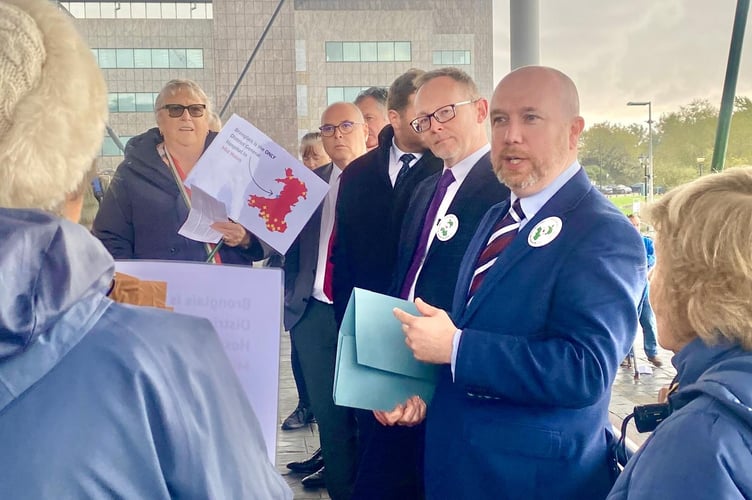
Stroke services across Ceredigion, Pembrokeshire and Carmarthenshire are a “matter for the health board”, the Welsh Government has told campaigners, despite the now Health Minister raising ‘grave concerns’ over the plan while in opposition.
Campaigners have called for clarity from Wales’ new Health Minister Mabon ap Gwynfor on his position on “dangerous” plans to downgrade stroke services at Bronglais Hospital in Aberystwyth with just a month left of a second consultation.
In October last year, politicians debated calls to safeguard full stroke services at Bronglais Hospital after more than 17,000 signed one of the biggest petitions in the Senedd’s 26-year history.
Campaigners have been urging the Senedd and Welsh Government to intervene immediately to protect the stroke unit amid plans to downgrade the service to a “treat-and-transfer” model.



Mabon ap Gwynfor, the then Plaid Cymru shadow health secretary and now Health Minister following his party’s victory in May, said during that debate that every minute counts in treating stroke and rehab is just as important to give patients the best chance to recover.
Mr ap Gwynfor, whose father is a stroke patient at Glangwili, said: “I have grave concerns about proposals for stroke services that I feel would lead to real harm.”
He argued Bronglais hospital is best placed to serve as a regional centre of excellence, warning sustainability must not come at the cost of access or quality.
He added: “Bronglais should be viewed as a solution, not a problem.”
Despite his words when in opposition, campaigners have failed to get a pledge from the now Health Minister to intervene as a consultation into stroke services continues until the end of July.
In a letter to Mr Ap Gwynfor, the campaign group Protect Bronglais Services (PBS) said there was “a feeling of collective dismay at what is happening to Bronglais”
“PBS is very concerned that Hywel Dda intend to press ahead with these proposals,” the group said.
“Given your stance during our campaign and indeed, your compelling words during the debate, PBS now ask you as our Welsh Government Health Minister to please intervene to ensure that this unsafe and dangerous plan to move Bronglais stroke patients to Glangwili for their rehabilitation, is not allowed to progress.”
While PBS did receive a reply to its letter, group chair Lisa Francis said it was “unusual” that it did not come from Mr ap Gwynfor himself, instead being sent by the Government Business Team for Health, Care and Prevention.
The reply indicated that the Welsh Government will not step in to stop the proposals, saying the plans were a “matter for the health board.”
“The Welsh Government recognises the strength of feeling locally about the future of stroke services in Mid and West Wales and acknowledges the significant engagement shown by you and others throughout this process, including the petition and your continued dialogue with Hywel Dda University Health Board,” the reply said.
“The Welsh Government fully appreciates the seriousness of the issues you have raised, particularly in relation to access to specialist stroke care, the distances patients may need to travel, the impact of transfer arrangements on patients and their families, and the importance of rehabilitation being delivered as close to home as possible wherever that is safe and clinically appropriate.
“These are matters of real significance for people requiring urgent treatment and longer-term support following a stroke.
“The Welsh Government is clear that any proposals for service change must be developed transparently, informed by evidence, and with full regard to quality, safety and patient experience.
“Decisions on the configuration of local NHS services, however, are matters for health boards, which are responsible for planning and delivering services for their populations within the appropriate statutory and governance framework.
“With access to clinical advice, operational data and local engagement, health boards are best placed to assess community needs and make accountable, evidence-based decisions affecting their populations.
“In doing so, they are expected to undertake thorough and robust assessments of any proposed changes, to engage meaningfully with the public in line with national guidance, and to identify and mitigate any risks arising from those proposals.
“For that reason, Protect Bronglais Services, and all those with an interest in this matter, are strongly encouraged to continue engaging fully in the consultation and to ensure that your detailed concerns are submitted as part of that process. Those representations will be an important consideration in the development of any future proposals.
“Welsh Government continues to engage regularly with health boards across Wales, and established governance arrangements are in place to monitor the quality, safety, performance and outcomes of the services they provide.”
Lisa Francis said the reply was “unusual” in not coming from Mr ap Gwynfor himself, but added that “one must assume that he's had a hand in it somewhere.”
Hywel Dda University Health Board endorsed the launch of a second phase of public consultation on the future of stroke services across its four main hospitals in late May.
It forms part of the wider Clinical Services Plan that the Health Board engaged upon in summer 2025.
A public consultation on the Clinical Services Plan last year drew more than 4,000 responses and led to a large protest meeting in Aberystwyth’s Great Hall, and more than 17,000 signing one of the biggest petitions in the Senedd’s 26-year history.
Hywel Dda Health board members in February were told the current service being offered was not achieving the standards required, but the board was told the service is safe currently.
The health board said that “stroke services in Hywel Dda do not consistently meet national clinical standards and are spread across four hospital sites with no specialist stroke cover available seven days a week.”
“This can impact outcomes and recovery for stroke patients,” the health board added.
No definite decision was made at that meeting on the future of stroke services, but a new plan then emerged - an amalgamation of new options presented to the health board in February.
The preferred option being consulted on includes a 24-hour acute stroke and rehabilitation unit at Glangwili Hospital; a stroke rehabilitation unit at Bronglais Hospital; and treat and transfer services at Bronglais, Prince Philip and Withybush hospitals, with patients transferred to Glangwili Hospital or a specialist thrombectomy centre where appropriate.
Information about the second phase of the consultation is available on the Health Board’s dedicated consultation webpages: https://hduhb.nhs.wales/stroke-consultation.
The consultation will run until 26 July.
Public meetings are expected to be arranged by PBS in both Aberystwyth and Machynlleth during July.
The second consultation will cost £71,809 to undertake, documents show.
The Health Board said it will “carefully consider all feedback from both phases of the consultation, alongside supporting evidence, data, clinical advice and impact assessments before making a final decision later this year.”
The health board said it would “seek to analyse the responses so that they can be brought to Board in November” but this “will be determined by level of responses received and may need to go to the next planned Board in January 2027.”
A final decision on the future of stroke services across the Hywel Dda University Health Board area would then be made.
Comments
We've recently changed our login process. If you have an account for commenting, you will need to re-register on the login window.
This article has no comments yet. Be the first to leave a comment.